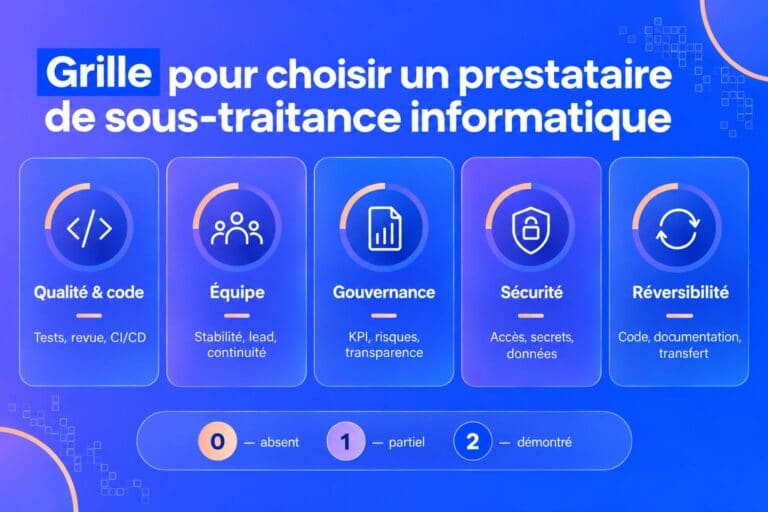
In a world where digital transformation is accelerating, organizations face a triple challenge: a shortage of talent, the urgency to innovate and pressure to optimize costs. IT outsourcing is therefore emerging as a major response.
Yet in 2026, this model no longer simply delegates operations: it is becoming a real strategic lever. IT outsourcing in 2026 embodies the shift toward trusted partnerships, greater agility and a rethought take on “offshore IT trends.”
For Etixio, it’s no longer just about outsourcing; it’s about co-creating, innovating and growing together.

1. Why IT outsourcing is gaining ground in 2026
1.1 A skills shortage driving a global search
Companies are finding it increasingly difficult to recruit qualified profiles in digital, AI, cybersecurity or cloud. According to one study, 57% of IT hiring managers report serious difficulty finding talent, while 43% expected to increase their headcount in 2025.
It’s in this context that IT outsourcing is taking hold: it provides access to a larger talent pool, often international, and makes it possible to build skills faster.
1.2 The IT outsourcing market is gaining momentum
The global IT outsourcing market is growing strongly. For example, it was estimated at USD 662 billion in 2025. This confirms that IT outsourcing is no longer a marginal option, but a major part of organizations’ IT strategy.
1.3 More than cost savings: a move up the value chain
Historically, outsourcing was mainly considered as a way to reduce costs. In 2025, things were already changing: only 34% of companies still cited savings as the main benefit.
The focus today is on:
- rapid access to specialized skills,
- faster time-to-market,
- operational flexibility,
- innovation and resilience.
2. Major IT outsourcing trends to watch
2.1 AI and automation built into outsourcing
AI is no longer a side topic: it is moving to the heart of outsourcing models. Intelligent processing, process automation, “human in the loop”: all levers for unlocking performance gains.
These new capabilities require IT outsourcing providers to integrate not only services, but also advanced technologies.
2.2 From offshore to nearshore: geography follows a new logic
While “offshore” remains present, “nearshore” is gaining popularity. Geographic proximity, time zone compatibility and cultural maturity are now essential criteria.
In Europe, or for French clients, this means favoring nearby regions or hybrid models, which makes management, agility and the quality of the relationship easier.
2.3 Cybersecurity as a must
With the rise in cyberattacks and the explosion of hybrid IT environments, security has become a decisive criterion in IT outsourcing contracts. Providers must now offer “zero-trust” architectures, compliance, audits and risk management.
For Etixio, this isn’t a cost: it’s a requirement for trust.
2.4 Outcome-based contracts and vendor consolidation
There is a shift toward “outcome-based” delivery models rather than “time & materials.” 67% of companies favor this type of contract. At the same time, vendor-stack consolidation is accelerating: companies want fewer suppliers, but more integrated partners.
For Etixio, this means choosing strategic partners rather than multiplying points of contact.
2.5 Hybrid outsourcing and flexible sourcing
The boundary between internal and external sourcing is blurring. We’re seeing hybrid models: part of the activities kept in-house, the other part outsourced (nearshore, offshore, service centers) to optimize agility and efficiency.
This approach combines the strengths of in-house (culture, control) with those of outsourcing (flexibility, cost, skills).
2.6 ESG commitment and sustainability in outsourcing
Outsourcing can no longer ignore environmental, social and governance (ESG) issues. Providers are expected to perform on working practices, energy consumption, waste management and talent diversity.
For Etixio, this dimension is a way to stand out: outsourcing, yes, but with a sense of responsibility.
3. How Etixio supports IT outsourcing in 2026
3.1 A vision centered on people and value
At Etixio, IT outsourcing isn’t a simple transfer of activity: it’s a partnership. Our teams become an extension of your business teams and share your culture, objectives and ambitions.
Each outsourcing engagement therefore aims to:
- free up in-house teams to focus on the core business,
- accelerate innovation,
- guarantee quality and commitment.
3.2 A range of services suited to 2026 challenges
Etixio offers services designed around the major IT outsourcing trends of 2026:
- agile development, application support, cloud & edge,
- cybersecurity & compliance,
- team augmentation (staff augmentation) or dedicated service centers,
- performance management and outcome-based contracts.
With this offering, outsourcing no longer means accepting rigidity, but gaining speed, quality and agility.
3.3 A smart geographic approach
Far from “all-offshore” stereotypes, Etixio favors proximity, smooth communication and cultural alignment. This can include nearshore or hybrid setups, depending on the client’s needs.
This flexibility makes it possible to combine:
- cost competitiveness,
- a high-quality relationship,
- optimal project follow-up.
3.4 Governance, security and performance at the core
Etixio sets up clear governance: dashboards, KPIs, quality management, well-defined SLAs. Security is built in from risk analysis through to day-to-day operations: certifications, compliance, regular audits.
Finally, the emphasis is on value creation: shorter time-to-market, skills development, visible return on investment.
4. IT outsourcing use cases and concrete benefits
4.1 Accelerating a digital project
Imagine a company that wants to launch a new web or mobile platform: thanks to IT outsourcing, it can quickly assemble an expert team, reduce time-to-market and control costs. Using nearshore components also enables smooth communication and agile management.
4.2 Strengthening cybersecurity
Faced with rising attacks and regulatory pressure, outsourcing IT security is becoming a strategic choice. An expert partner can provide 24/7 monitoring, incident response and compliance, while freeing up in-house teams. According to the data, the success rate of outsourcing critical functions reaches 85%.
4.3 Scaling the team to build skills
A fast-growing company may not have the internal resources to meet all its needs (AI, cloud, edge, DevOps). Outsourcing makes it possible to add “plug & play” skills without the usual recruitment delays. It also enables a hybrid model where the core stays in-house and peaks or specialist expertise are outsourced.
4.4 Optimizing costs and flexibility
Even if it’s no longer the only driver, cost optimization remains a real benefit. Outsourcing avoids heavy upfront investments, allows stable or recurring functions to be outsourced, and turns fixed costs into variable costs. According to studies, some areas such as help desk show a 91% success rate in reducing costs.
5. Challenges to anticipate and how to overcome them
5.1 Governance and change management
Outsourcing doesn’t happen on “autopilot.” You need to define clear governance models, ensure communication between internal and external teams, and prepare the ground for change. Resistance, misaligned expectations or lack of visibility are classic obstacles.
5.2 Security, data and compliance risks
Data is a strategic asset: choosing an outsourcing partner means checking certifications, security processes, backup and restore arrangements, and local/international compliance. A prior audit, an integration plan and a clear separation of responsibilities are essential.
5.3 Choosing the right model (offshore vs nearshore vs hybrid)
The temptation of “low-cost offshore” remains strong, but it isn’t always the right model. Obstacles can include time zones, language or cultural barriers, and management complexity. Conversely, nearshore or hybrid can offer the proximity needed for strategic projects. The right model depends on the need, the level of innovation, criticality and internal maturity.
5.4 Prioritizing value over mere cost
To succeed, outsourcing must be value-driven. This means setting clear objectives and performance indicators, and aligning the provider with the company’s ambitions (go-to-market, innovation, user experience). A provider that sees itself only as a low-cost “subcontractor” will quickly be outpaced.
6. Recommendations for successful IT outsourcing
1- Define a clear strategic vision Before delegating, ask yourself: “What is the goal of this outsourcing?” (agility, skills development, innovation, shorter time-to-market…).
2- Map internal skills and gaps Identify what you want to keep in-house, what you want to outsource, and why.
3- Choose the right provider, in the right location Favor partners who share your values, have the targeted skills and understand your industry.
4- Structure the contract around outcomes Avoid just “hours & resources”: favor SLAs, performance indicators, quality management and business objectives.
Set up solid governance Dashboards, regular meetings, cross-functional communication, a clear role for each party, change management.
5- Measure and showcase the benefits Don’t see outsourcing as a hidden cost: track productivity gains, acceleration and innovation delivered, and communicate them.
6- Build a lasting partnership Outsourcing only becomes a driver of innovation if the provider is treated as a strategic partner, not just a supplier.
In 2026, IT outsourcing is entering a new era. It’s no longer just about “getting tasks done” at lower cost, but about “co-creating” value, accelerating innovation, accessing rare skills, and guaranteeing quality and resilience.
Terms like “offshore IT trends” or “IT outsourcing” take on a whole new meaning: smart geographic hybridization, AI integration, stronger security, outcome-based contracts.
For Etixio, this evolution is an opportunity: to support organizations through this transformation, and to think of outsourcing as a sustainable, human and agile growth lever.
If you want to get the most out of IT outsourcing in 2026, bet on the right partner, a clear vision and rigorous management. The future of outsourcing starts today.
Etixio helps you turn it into a real engine of innovation and performance. Contact us!
FAQ
Why has IT outsourcing become strategic for companies in 2026?
IT outsourcing now addresses major challenges: talent shortages, accelerating digital projects and cost pressure.
In 2026, it’s no longer just about outsourcing tasks, but about relying on a partner to gain agility, access key skills and accelerate time-to-market.
What are the concrete benefits of IT outsourcing for a company?
IT outsourcing improves flexibility, shortens implementation times and provides access to expertise that’s hard to recruit in-house.
It also helps optimize costs while strengthening the quality of deliverables and the capacity to innovate.
What is the real cost of an IT outsourcing project?
The cost of IT outsourcing depends on the chosen model (offshore, nearshore or hybrid), the level of expertise and the outsourced scope.
In most cases, outsourcing turns fixed costs into variable costs and optimizes budgets while maintaining a high level of performance.
How do you choose between offshore, nearshore and a hybrid model?
The choice depends on several criteria: project criticality, need for proximity, technical complexity and the expected level of collaboration.
Offshore helps optimize costs and access a large talent pool, while nearshore makes communication easier. The hybrid model combines both to maximize performance and agility.
What are the key success factors of an IT outsourcing project?
The success of an IT outsourcing project rests on clear governance, rigorous data management and smooth collaboration between internal and external teams.
By structuring roles, defining key performance indicators (KPIs) and relying on solid contracts (SLAs), companies secure their outsourcing and turn it into a lasting performance lever.
What mistakes should you avoid in an IT outsourcing project?
Difficulties in IT outsourcing most often stem from a lack of initial scoping rather than from technology. The most common mistakes are unclear governance, poorly defined objectives, the wrong choice of partner or insufficient communication between internal and external teams.
To avoid these pitfalls and structure your approach effectively, you can read our complete guide to succeeding with your offshore IT outsourcing project, which details best practices, key steps and success factors.
How does a partner like Etixio make a difference in an IT outsourcing project?
A partner like Etixio brings a structured approach to outsourcing: a combination of technical expertise, clear governance, a well-managed offshore model and alignment with business objectives.
The goal is to turn outsourcing into a lasting performance lever, not just a way to cut costs.