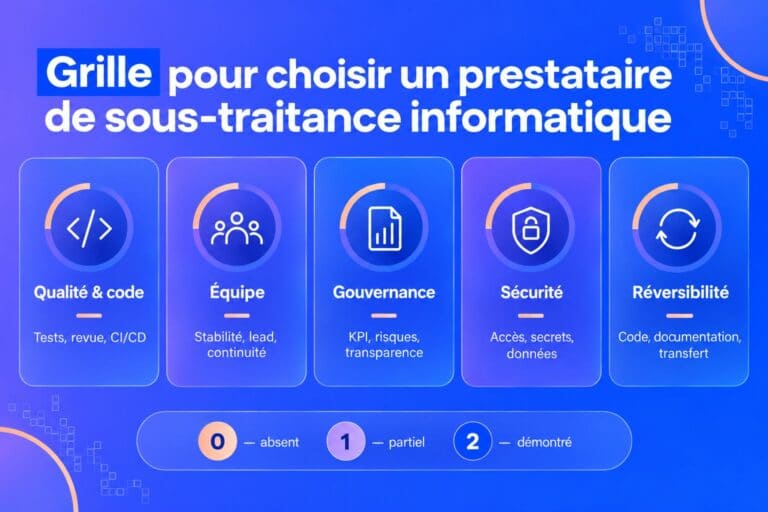
Outsourcing a digital project is no longer just a question of budget. For many IT and business leaders, it has become a lever for speed, scalability and delivery continuity. But an offshore web agency is not a magic wand: the right partner accelerates your roadmap, the wrong one costs you time, money… and sometimes internal trust.
In this article, we’ll look at how to choose an offshore web agency in Madagascar (and more broadly) based on concrete criteria: organization, methods, quality, security, communication, business model and governance.
The goal: help you succeed with a web and mobile development project alongside a reliable partner, without losing control.
The promise: by the end, you’ll have a clear (and reusable) framework to select the right provider, scope your collaboration and steer performance.

Why work with an offshore web agency, and why in Madagascar?
For an overview of the country (languages, time zone, tech ecosystem), see our page on software development in Madagascar; to build a team, see our developers in Madagascar.
The point is not “offshore = cheaper”. The point is: which mix of cost / quality / speed / flexibility serves your product strategy. Outsourcing web and mobile development can address several needs:
- Accelerate time to market (MVP, new features, redesign).
- Strengthen an internal team (talent shortage, activity peak).
- Industrialize delivery (sprints, QA, CI/CD, application maintenance).
- Reduce risk (skills redundancy, operational continuity).
Why is Madagascar often a relevant choice?
Madagascar combines several frequently sought-after advantages:
- A pool of French-speaking talent (smoother communication for teams in France, Belgium, Switzerland and Canada).
- A time zone compatible with Europe (and good overlap with Asia depending on your organization).
- An attractive quality/cost ratio, provided the partner has a genuine quality management system.
The 7 criteria that separate a “provider” from a “partner”
When you set out to choose an offshore web agency, ask yourself this question: does this agency know how to deliver a project, or does it know how to make you succeed over time?
Here are the most decisive criteria.
1) Ability to scope (and challenge) your requirement
A good offshore web agency does more than execute. It knows how to:
- Rephrase the requirement and identify gray areas.
- Propose alternatives (scope, UX, architecture, costs).
- Translate business intent into a prioritized backlog.
Positive signals
- Scoping workshops (discovery), user stories, acceptance criteria.
- Architecture proposals + risks + mitigation plan.
- MVP → V1 → V2 roadmap.
Red flags
- An instant quote without any questions.
- “We can do everything” with no breakdown or assumptions.
- No explicit method for handling scope changes.
2) The right delivery model: fixed-price, time & materials, dedicated team
The choice of model determines 80% of success.
- Fixed-price: useful if the scope is stable, but high risk if your needs evolve (which almost always happens).
- Time & materials (technical assistance): flexible, good for accelerating, requires solid governance on the client side.
- Dedicated team: often the best compromise for a living product: stability, skills growth, velocity.
If you’re aiming for an offshore dedicated web development team, check:
- The staffing process and actual seniority.
- Stability (turnover, backup).
- The ability to handle web + mobile + QA + DevOps.
3) Proven technical expertise (not just a “list of technologies”)
An offshore React/Node agency in Madagascar or a “mobile” agency can list every stack… without knowing how to industrialize. Ask for proof:
- Code samples (or a repo audit if possible).
- Standards: linting, conventions, architecture, design system.
- Testing strategy: unit, integration, E2E.
- Observability: logs, monitoring, alerting.
Goal: reduce the risk of technical debt and premature rewrites.
4) Quality & QA: the crux of the matter
If you outsource, you must demand a real approach to quality. The question isn’t “do you have testers?” but: how is quality designed, measured and improved?
Best practices to look for:
- Automated QA testing: CI pipeline, unit + integration + E2E tests.
- A clear Definition of Done (code review, tests, documentation, security).
- Environments (dev/staging/pre-prod/prod) and a release strategy.
- Bug management (SLA, prioritization, post-incident RCA).
Red flags
- QA only “at the end of the project”.
- No CI/CD.
- No metrics (defect rate, coverage, lead time).
5) Communication & steering: the difference between “it’s moving” and “it ships”
The real offshore risk is rarely technical; it lies in coordination.
Make sure the agency masters:
- Agile project management with an offshore team: rituals, backlog, sprint goals, demos.
- Useful (not heavy) documentation: decisions, ADRs, runbooks, onboarding.
- Transparency: velocity, risks, trade-offs.
Communication checklist
- A short daily stand-up (15 min) for a dedicated team.
- A weekly governance meeting (KPIs + risks + priorities).
- A demo every 2 weeks (or at each release).
- A single channel (Slack/Teams) + one tool (Jira/Linear/Trello).
6) Security & compliance (GDPR, access, data)
Data security must be addressed from day one.
Essential questions:
- Where are the data and environments hosted?
- How is access managed (SSO, MFA, bastion, RBAC)?
- What is the secrets policy (vault, rotation, audits)?
- What contractual clauses apply (confidentiality, subcontractors, DPA)?
If your project involves sensitive data (healthcare, finance, HR), require:
- Strict environment isolation.
- Access logging.
- An incident process (who does what, and within what timeframe).
7) Ability to maintain: application maintenance, support, enhancements
A successful project is one that keeps running well long after go-live. Your agency should offer:
- An offshore application maintenance support SLA (S1/S2/S3, response/resolution times).
- A correction + prevention process (post-mortems, technical backlog).
- A run plan + knowledge transfer.
Madagascar: how do you concretely assess a “good” provider?
If you’re looking for the best web development provider in Madagascar, forget general promises and look at verifiable evidence.
What to ask for as soon as you have a shortlist (3–5 agencies)
- A comparable case study (industry, complexity, stakes).
- An example of governance (rituals, KPIs, tools).
- An example of a quality plan (DoD, tests, CI/CD).
- An example of staffing (seniority mix + backup).
- A model proposal (fixed-price/time & materials/dedicated) with assumptions.
A simple and very effective test: the “mini-audit”
Before signing, propose a scoped 1- to 2-week “trial”:
- architecture review,
- delivery plan,
- MVP breakdown,
- estimate,
- proof of concept on one component.
This mini-audit immediately reveals the partner’s real maturity, without committing to a full project.
Costs: what you really pay for (and how to avoid unpleasant surprises)
The cost of offshore web development in Madagascar should be assessed as a total cost:
- production cost (dev, QA, DevOps),
- steering cost (product, tech lead, coordination),
- cost of poor quality (bugs, rework, rewrites),
- turnover cost (loss of knowledge).
The 4 levers that drive the budget
- Functional complexity (workflows, roles, back office).
- Technical complexity (real time, integrations, data).
- Quality/security requirements (tests, audits, compliance).
- Expected product level (UX, performance, scalability).
Rule of thumb: a “cheaper” offshore setup that generates debt costs more within 6–12 months.
Contract: fixed-price vs time & materials vs dedicated team (and how to choose)
Many failures stem from the wrong contract, not the wrong developers.
Time & materials vs fixed-price offshore contract: how to decide
- Fixed-price if: stable scope + detailed specs + low uncertainty.
- Time & materials if: evolving needs + continuous prioritization + close collaboration.
- Dedicated team if: long-term product + need for speed + knowledge building.
For most digital products, a hybrid format works very well:
- discovery (scoping) as a “fixed-price” engagement,
- delivery with a “dedicated team”,
- application maintenance with an SLA.
Integrating an offshore team without losing control
The classic friction point: “we outsource, so we lose our grip”. In reality, you stay in control if you structure governance.
The fundamentals
- A PO/PM on the client side who prioritizes (even part-time).
- A technical lead (CTO/lead) who validates architecture and standards.
- Short, regular, fact-based rituals.
- A clear Definition of Done.
Simple (and very telling) KPIs to track
- Lead time (idea → production).
- Deployment frequency.
- Production bug rate.
- “Run vs build” ratio (maintenance vs new features).
- Application maintenance availability and response time.
That’s how you integrate an offshore team into an internal team without creating silos.
Recommended process: the safest path to success
Here is a robust process for offshore web and mobile development:
- Discovery (1–3 weeks): objectives, scope, risks, roadmap, MVP backlog
- Setup (1 week): environments, CI/CD, conventions, security, tools
- Agile delivery (2-week sprints): demos, feedback, regular releases
- Controlled go-live: checklists, monitoring, rollback plan
- Application maintenance & continuous improvement: SLA, post-mortems, performance/cost optimization
Why Etixio? An offshore agency built as a “partner”
At Etixio, our approach is simple: we don’t sell man-days, we build teams and a delivery system.
- Rigorous selection of profiles (web & mobile).
- Pragmatic, results-oriented agile methods.
- Quality by design: tests, CI/CD, code review, DoD.
- Clear governance: KPIs, risks, action plan.
- Madagascar as a talent hub + French-speaking proximity.
If you’re looking for an offshore web agency in Madagascar for a web or mobile project, or a dedicated team, the goal is the same: deliver fast, deliver well, and deliver for the long term.
FAQ
How do you choose an offshore web agency in Madagascar to make sure your project succeeds?
Choosing an offshore web agency in Madagascar comes down first and foremost to its ability to structure delivery and align with your business goals. You need to assess the quality of its scoping (discovery, backlog, prioritization), the maturity of its engineering practices (testing, CI/CD, code review) and the governance it puts in place (rituals, performance indicators, reporting).
A reliable partner does more than execute: it challenges the requirement, proposes trade-offs and brings a product vision. In this context, a mini-audit or an initial scoping phase lets you validate, in practice, the agency’s method, skills and ability to secure your project over time.
Why choose Madagascar for an offshore web development project?
Madagascar is a preferred destination for web outsourcing thanks to its French-speaking workforce, its cultural proximity to Europe and its compatible time zone. These factors make communication easier and speed up decision-making.
Combined with solid technical skills and a structured delivery model, Madagascar makes it possible to optimize the quality/cost ratio while maintaining high standards.
Which model should you choose with an offshore web agency: time & materials, fixed-price or dedicated team?
The right model depends on your project and your internal organization. A fixed-price project suits a stable scope, time & materials offers more flexibility, and a dedicated team is often the best choice for an evolving product.
In most cases, a hybrid model works best: initial scoping as a fixed-price engagement, followed by delivery with a dedicated team to ensure speed, quality and continuity.
What concrete factors help you assess an offshore web agency before committing?
Before choosing an offshore web agency, you need to assess concrete elements: scoping capability, delivery examples, team organization, quality practices and governance model.
A short trial, such as a mini-audit or a discovery phase, lets you validate the partner’s understanding of your needs, the quality of communication and its maturity. This step is often decisive in securing your choice and avoiding gaps between the sales pitch and operational reality.
Clear steering turns offshore into a performance lever rather than a source of complexity.
What quality standards should you require from an offshore web agency?
A high-performing offshore web agency builds quality in from the very start of the project. That includes practices such as automated testing, dedicated QA, systematic code reviews, CI/CD pipelines and a clear Definition of Done.
These standards secure delivery, limit technical debt and keep the product stable over time. Without a structured quality framework, even a well-sized project can quickly lose efficiency.
To structure these requirements, you can rely on our guide to quality standards in IT outsourcing, which details the best practices, key indicators and methods used on demanding offshore projects.
What should an application maintenance SLA with an offshore agency include?
An application maintenance (TMA) SLA should clearly define priority levels (S1, S2, S3), response and resolution times, and availability commitments.
It should also cover incident management processes, monitoring mechanisms and performance indicators. A well-structured SLA guarantees service continuity and support quality after the production release.