IT outsourcing in Madagascar is attracting more and more French and French-speaking companies looking to accelerate their digital projects while keeping budgets under control.
But while Madagascar is an excellent outsourcing destination, success doesn’t depend on the country alone: it depends on a delivery method, clear governance and a consistently high standard of quality and security.
In this complete guide, we cover the essentials for making your IT outsourcing in Madagascar a success: benefits, costs, models, risks, security/GDPR and field-tested best practices.
The goal: to give you a concrete, actionable framework and help you avoid costly mistakes (delays, rework, technical debt, friction).

Why choose IT outsourcing in Madagascar?
Our page Madagascar: building your software with French-speaking engineers presents the country and how we work there; our developers in Madagascar offering explains how a dedicated team operates.
A French-speaking workforce that really makes a difference
In most outsourced projects, misunderstandings rarely come from “bad will”. They come from imprecise communication: lost nuances, poorly rephrased requirements, misunderstood priorities. Madagascar offers a strong advantage: the French language and a communication culture compatible with the standards of French-speaking organizations.
The result:
- smoother workshops,
- better-understood specifications,
- faster decisions,
- fewer back-and-forths during acceptance testing.
Cultural proximity that improves collaboration
The success of an IT project often depends on the day-to-day relationship: feedback, transparency, the ability to say “no”, escalation of risks, quality of reporting. Madagascar is known for a strongly service-oriented attitude and high commitment, which helps build a lasting collaboration, provided the right framework is set from the start.
A time zone compatible with France
Madagascar is two hours ahead of Paris in winter and one hour in summer: synchronous rituals (daily stand-ups, workshops, demos) take place during your office hours. This point is often underestimated: when overlapping hours are too limited, the project quickly slips into “forced asynchrony” (latency, frustration, slowdown).
A good value-for-money ratio (not just “cheaper”)
The best reason to outsource to Madagascar is not to “cut costs at all costs”. It’s to achieve more robust delivery overall: a larger team, integrated QA, documentation, testing, CI/CD, runbooks. In other words: better industrialization.
Madagascar: which types of projects are best suited to outsourcing?
IT outsourcing in Madagascar works particularly well for:
- web development (front end/back end),
- business application development,
- application maintenance / evolutionary maintenance,
- QA & test automation,
- DevOps (depending on the partner’s maturity),
- building a product team (dedicated team).
Conversely, contexts that call for more caution:
- a very vague / unstable scope,
- dependency on poorly documented legacy systems,
- extremely strict security requirements without a control framework,
- a client organization with no available owner (no PO/PM on the client side).
Costs of IT outsourcing in Madagascar: how to think about them?
The engagement models and their implications
1) Staff augmentation: short time and materials
One or more of our engineers (developers, QA, DevOps) join your team for a specific skill or a workload peak, while remaining led by our tech leads.
Benefits:
- flexibility,
- direct management,
- good for reinforcing an existing team.
Risks:
- dependency on client-side management,
- drift if the backlog/priorities are poorly managed.
Ideal if you have a solid PO/PM and an already structured organization.
2) Dedicated team (time and materials)
You build a squad (e.g., 1 lead, 2 developers, 1 QA) with a delivery framework and shared steering.
Benefits:
- stability,
- continuity,
- ramp-up,
- knowledge capitalization.
Often the best performance/control trade-off for a strategic project.
3) Time and materials project
A project with an objective, a scope and an Etixio lead, billed for time spent. It is the right framework beyond about 3 months, when a pure fixed price is no longer sustainable: you keep flexibility on scope, we stay committed to running the project.
4) Fixed-price project
A commitment on scope, budget and deadline. Very effective… if the scoping is clean.
Benefits:
- visibility,
- clear commitment,
- good for well-defined work packages.
Risks:
- tension if the scope changes,
- difficult trade-offs when the unexpected happens.
Best when the need can be “specified” and is stable.
Hidden costs to anticipate
- insufficient scoping → rework,
- no QA → bugs and production issues,
- poor documentation → dependency,
- weak governance → drift,
- technical debt → gradual slowdown,
- turnover → loss of knowledge.
Golden rule: compare offers at the same level of governance + quality. Otherwise you’re comparing apples and oranges.
The risks of outsourcing to Madagascar, and how to neutralize them
Risk #1: scoping that’s too light
A “ballpark” brief creates months of friction.
Best practices:
- clear business objectives,
- explicit scope,
- acceptance criteria,
- definition of Done,
- prioritization (MoSCoW or equivalent).
Risk #2: absent or overly “light” governance
Without rhythm and transparency, outsourcing goes off the rails.
Best practices:
- short daily stand-up,
- weekly demo,
- risk review (weekly),
- monthly roadmap,
- simple KPI reporting.
Risk #3: sacrificed quality
Delivering fast at first and then slowing down is a classic.
Best practices:
- PRs + code review,
- tests (unit, integration, e2e as needed),
- dedicated QA,
- CI/CD,
- quality gate before release.
Risk #4: dependency on a key person
When only one person knows “the system”, you’re taking an organizational risk.
Best practices:
- shared ownership,
- pair programming at the start,
- living documentation,
- backup.
Risk #5: security and GDPR
Outsourcing doesn’t remove your responsibilities.
Best practices:
- MFA, fine-grained access management (least privilege),
- separate environments,
- secrets management,
- auditability (logs),
- contractual clauses + incident procedure.
Our best practices for successful outsourcing in Madagascar
1) Start with a short “Discovery”
Goal: clarify and reduce uncertainty. Recommended deliverables:
- prioritized backlog,
- high-level architecture,
- release plan,
- risks/assumptions,
- estimate (realistic range).
2) Set up simple but solid governance
- Weekly: demo + planning + risks
- Monthly: budget + roadmap + trade-offs
- At every release: quality validation + go/no-go
3) Industrialize delivery from week 1
- clean repository,
- coding conventions,
- CI pipeline,
- PR rules,
- environments,
- monitoring/logging.
4) Secure onboarding + knowledge capitalization
- onboarding checklist,
- accessible documentation,
- runbooks,
- organized knowledge transfer.
5) Measure and steer
Useful KPIs:
- lead time,
- bug rate,
- release frequency,
- production stability,
- satisfaction.
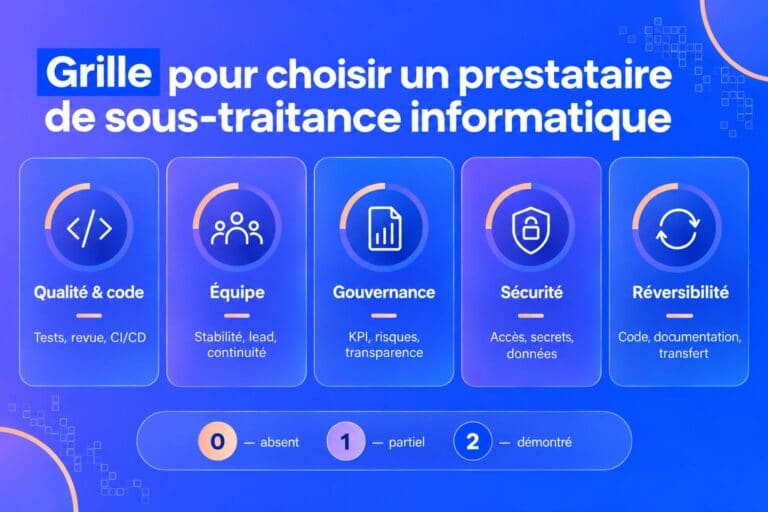
How do you choose a provider in Madagascar?
Questions that reveal maturity
- What is your QA process?
- How do you manage security and access?
- What is your CI/CD standard?
- Who manages delivery?
- How do you handle documentation and handover?
- Do you have similar references (stack, context, size)?
Red flags
- no clear method,
- no QA,
- no governance,
- unrealistic promises,
- vagueness about code ownership and documentation.
To conclude
IT outsourcing in Madagascar can be a powerful lever, provided you treat it as a delivery system (not as a purchase of “resources”). With scoping, regular governance, a genuine quality culture and a clear security framework, Madagascar becomes an effective and sustainable choice.
Are you considering IT outsourcing in Madagascar?
At Etixio, our French-speaking engineers in Madagascar and Mauritius deliver software and AI solutions, with AI in their daily work. We help you choose the right model (dedicated team or staff augmentation, time and materials project, fixed-price project), secure quality and set up simple, effective governance.
IT outsourcing in Madagascar: frequently asked questions
Why choose Madagascar for IT outsourcing?
Madagascar is now a recognized destination for IT outsourcing, notably thanks to its French-speaking workforce, its cultural proximity to European companies and its compatible time zone.
These factors make communication easier, reduce misunderstandings and enable smooth day-to-day collaboration.
Beyond cost, Madagascar offers a good balance between delivery quality, team commitment and the ability to industrialize projects (QA, documentation, CI/CD), provided you work with a structured partner.
How much does IT outsourcing in Madagascar cost?
The cost of IT outsourcing in Madagascar depends on the model chosen (staff augmentation, dedicated team or fixed-price project), the level of expertise and the scope of the project.
On average, companies see savings of 30 to 50% compared with local teams, while gaining access to qualified skills.
However, the real cost must factor in governance, delivery quality, documentation and the processes in place. A cheaper but poorly structured offer can generate significant hidden costs (rework, bugs, delays).
What are the key success factors for an offshore project in Madagascar?
An offshore project in Madagascar succeeds when it rests on clear scoping, structured governance and smooth communication between teams. Key elements include well-defined objectives, a prioritized backlog, regular rituals (daily stand-up, demo, risk tracking) and performance indicators.
In this context, product scoping plays a decisive role: a Product Owner or a well-structured steering setup aligns the teams, prioritizes effectively and prevents drift from the earliest phases of the project.
Success therefore depends less on the country than on the delivery method and the partner’s ability to structure the project over time.
Which model should you choose in Madagascar: staff augmentation, dedicated team or fixed-price?
The choice of model depends on your organization’s maturity and the nature of the project.
- Staff augmentation is suited to reinforcing an existing team with more flexibility.
- A dedicated team lets you build a stable squad whose skills grow over time.
- A time and materials project suits long projects: one objective and an Etixio lead, billed for time spent.
- A fixed-price project is relevant for short, well-scoped projects with a defined scope.
In most cases, a dedicated team offers the best balance between performance, control and continuity.
How do you guarantee quality in IT outsourcing in Madagascar?
Quality in outsourcing relies on industrializing delivery from the very start of the project.
This includes putting practices in place such as code review, automated testing, dedicated QA, CI/CD pipelines and clear validation criteria before each production release.
Without these elements, projects can quickly accumulate technical debt. Quality is not optional: it must be built into the teams’ daily operations.
How do you manage turnover and secure knowledge in an offshore team?
Turnover is a reality in every IT environment, including offshore.
To secure continuity, it is essential to set up an organization based on knowledge sharing: living documentation, pair programming, structured onboarding and collective code ownership.
These practices limit dependency on any single person and ensure the project’s stability over time.