The cost of offshore outsourcing is one of the first questions IT departments, CTOs and business leaders ask when they consider strengthening their development capacity. And for good reason: the promised savings are significant, sometimes up to 40 or 60% compared with a local team.
Yet behind these attractive figures lie subtler mechanics, often underestimated parameters and a real steering challenge. Reducing the analysis to the rate of an offshore developer alone is like comparing the purchase price of a car without looking at its fuel consumption, maintenance or lifespan.
In this article, we break down the real offshore cost of a development team: daily rates, engagement models, hidden costs, steering costs, quality, ROI…
You’ll also find an offshore vs. local cost comparison, an overview of destinations, and concrete levers to optimize your offshore IT project budget. The goal: to give you a complete, transparent and operational view so you can decide with full clarity.

Understanding offshore IT outsourcing
Offshore outsourcing means entrusting part or all of your offshore software development to a provider located in another country, generally with a more favorable hourly cost. Offshore IT services now cover a very broad spectrum: offshore custom software design, application maintenance, systems integration, data, cloud, DevOps, cybersecurity, and also the management of complex projects.
Three main models dominate the market:
- The offshore dedicated team: a group of developers working exclusively for you, steered by you or by the provider.
- The offshore development center: a true extension of your IT department, structured like a capacity subsidiary, with dedicated governance, HR and processes.
- Project or fixed-price mode: the offshore IT service is delivered according to defined specifications, budget and timeline.
Each model has a direct impact on the cost of the offshore IT project, on the quality of the deliverable and on the internal coordination workload.
The components of offshore outsourcing cost
The cost of offshore development never boils down to an hourly rate multiplied by a number of days. It’s a composite cost that needs to be broken down so you don’t get caught off guard.
The offshore developer’s daily rate: a first indicator
The daily rate of an offshore developer is the most visible element. Depending on the country and seniority level, it generally ranges from €150 to €500 per day. As an indication:
- Madagascar, Mauritius, Senegal: €180 to €350 / day
- North Africa (Morocco, Tunisia): €250 to €450 / day
- India: €150 to €400 / day
- Eastern Europe (Romania, Ukraine, Bulgaria): €250 to €500 / day
But be careful: the price of an offshore team isn’t calculated by simply adding up daily rates. You need to factor in the additional costs detailed below.
Steering and coordination costs
A remote team requires more rigorous orchestration than a team on the same floor. This includes product steering, roadmap management, agile rituals, incident resolution, asynchronous communication, and the cultural translation sometimes needed between your business teams and the offshore team. Depending on team size and project complexity, steering an offshore team typically represents 10 to 20% of the total budget.
Quality and delivery costs
Testing, code reviews, functional acceptance testing, bug management, documentation: these items are sometimes underestimated. Yet they determine the real value delivered. An insufficiently supervised team can generate costly technical debt that wipes out the savings of offshore outsourcing within a few months.
Onboarding and knowledge transfer costs
Starting an offshore project generally requires 2 to 6 weeks of ramp-up: understanding the business, getting to grips with the code, aligning on standards, setting up access and tools. This phase is an investment, to be included in the real offshore cost.
Offshore development cost: overview by destination
The geographical choice has a strong influence on the cost of an offshore IT project. Here are the main trends observed on the European market.
Madagascar and the French-speaking Indian Ocean offer an excellent compromise for French companies: native French speakers, a compatible time zone (UTC+3), a strong appetite for modern technologies, and competitive costs. It’s one of the most cost-effective destinations for building a stable offshore development center.
North Africa (Morocco, Tunisia) remains very popular thanks to cultural and linguistic proximity, with slightly higher daily rates.
India offers the largest volumes and very competitive rates, but requires strong steering discipline and sometimes demanding linguistic alignment.
Eastern Europe combines strong technical skills and time-zone proximity with Western Europe, but price gaps are narrowing year after year.
So the question isn’t just “where is it cheapest?” but “where will I find the best cost / quality / sustainability ratio for my offshore IT project budget?”.
Outsourcing models and their budget impact
The choice of model determines both the price of a team and how much control you keep over your project.
The offshore dedicated team
The dedicated team is favored by companies with a continuous need for development capacity. You benefit from a stable group that gradually builds up expertise on your product and your business. The cost is spread over time and budget predictability is high. It’s also the model that maximizes the ROI of offshore outsourcing over time, as productivity increases month after month.
The offshore development center
The offshore development center goes further: it’s a true organizational extension, with dedicated HR, finance, security and governance. Suited to mid-sized companies and large enterprises, it secures sustainability, intellectual property and compliance. The entry cost is higher, but the profitability of offshore outsourcing over 3 to 5 years is generally excellent.
Project or fixed-price mode
A fixed-price project is useful for work with a clear scope: a redesign, an MVP, a functional component. The provider commits to a deliverable, a deadline and a price. Be careful: any change in scope triggers a contract amendment. This model is less flexible for evolving custom software.
The hidden costs of IT outsourcing
This is often where the real difference between initial promises and the real offshore cost plays out. The main hidden costs of IT outsourcing to anticipate are the following.
- Insufficient initial scoping. A poorly defined need results in back-and-forth, rework, misunderstandings and, ultimately, a budget overrun. It’s by far the leading cause of extra costs.
- Quality rework. When the delivered code doesn’t meet the expected standards, it has to be refactored, retested, sometimes rewritten. Cheap development that has to be reworked ends up costing more than development structured from the start.
- Delivery delays. Each month of delay affects the business value produced, sometimes well beyond the cost of the team itself.
- Team turnover. If your provider doesn’t secure the retention of its people, you pay several times for the same ramp-up.
- Tools and licenses. GitHub, Jira, Figma, cloud environments, security tools: to be included in the overall offshore outsourcing cost.
- Risk management. Security, GDPR compliance, intellectual property, business continuity plan: these dimensions have a cost, but their absence has a much greater one.
Want to estimate the real cost of your offshore project?
Offshore vs. local cost comparison: the real calculation
The offshore vs. local cost comparison is rarely done thoroughly. It shouldn’t be limited to the raw daily rate, but should include the total employer cost.
- For an experienced developer in France, the full cost of a working day (salary with payroll charges + management + premises + tools + training + leave + absences) is generally between €500 and €750.
- For a senior freelancer, expect €550 to €800 excl. VAT per day.
- For an equivalent offshore dedicated team, the full cost (daily rate + steering + quality) is often between €280 and €450 per day.
The net savings of well-executed offshore outsourcing are therefore between 30% and 50%, after taking all indirect costs into account. That’s significant, but it’s not the 70% savings sometimes announced in sales pitches.
An offshore developer’s daily rate should therefore always be compared with the full local cost, not with the gross salary alone. It’s the only way to reach a rational decision.
Calculating the ROI of your offshore outsourcing
The ROI of offshore outsourcing rests on three variables: the savings achieved compared with an equivalent local team, the actual productivity of the offshore team, and the business value generated by the deliveries.
A simple calculation consists of comparing, over 12 months:
- the full cost of an equivalent local team,
- the cost of a complete offshore IT project (daily rate, steering, quality, onboarding, tools, risks),
- the productivity delta (positive or negative) between the two setups,
- the business value produced (revenue, productivity gains, time-to-market).
When the organization, the partner and the steering are aligned, the ROI of offshore IT outsourcing can be measured in the first year, and grows over 2 to 3 years as the team becomes more autonomous.
How to avoid cost overruns and optimize your offshore IT project budget
Experience shows that cost differences between two equivalent projects are explained less by the country than by the quality of the setup. Here are the most effective levers to keep your offshore IT project budget under control.
- Scope upfront, seriously. Clear product scoping (objectives, user journeys, scope, acceptance criteria) prevents most drift. Investing one to two weeks in scoping often saves dozens of development days.
- Choose a partner that secures recruitment. Good offshore developer recruitment is the cornerstone of performance. Solid technical profiles, cultural alignment, the ability to understand the business: these make the difference over time.
- Set up simple but real governance. Daily stand-up, sprint review, retrospective, weekly product meeting, monthly steering committee: these rituals structure the collaboration and limit blind spots.
- Measure quality. Test coverage, bug rate, lead time, cycle time, user satisfaction: a project that is measured is a project that improves.
- Invest in documentation. It’s the life insurance of your offshore software development: it reduces dependence on individuals, speeds up onboarding and secures continuity.
- Plan the ramp-up. A team that grows gradually is better than an oversized team that struggles to deliver.
Offshore developer recruitment and offshore team management
Beyond an offshore developer’s rate, two dimensions shape performance over time: recruitment and steering.
On the recruitment side, the quality of sourcing, the rigor of technical tests, the assessment of soft skills and cultural alignment are decisive. A senior developer costs more, but their productivity, their ability to make technical decisions and to train junior profiles more than justify the investment.
On the steering side, you need an effective pair: a Product Owner or business referent on the client side, and a tech lead or delivery manager on the offshore side. This backbone ensures constant translation between the business need and technical execution. Without it, even the best developers produce code that misses the target.
The Etixio approach to effective offshore IT outsourcing
At Etixio, we have built our offshore IT services around a simple conviction: the value of an offshore IT service isn’t measured by the lowest daily rate, but by the regularity of deliveries and the sustainability of the collaboration.
That’s why we combine three levers:
- Recruiting solid technical profiles, selected for their real skills and their fit with your project culture.
- Supervision by experienced tech leads and delivery managers, who secure quality, deadlines and communication.
- Continuity: team retention, knowledge transfer, continuous upskilling, anticipation of departures.
Whether you’re looking to build an offshore dedicated team, set up an offshore development center or hand over a one-off project, our teams support you from scoping through to go-live, and on into run operations.
Real-world examples: what does an offshore budget look like in practice?
To make the notion of offshore outsourcing cost tangible, here are three typical scenarios observed with our clients.
Case 1 – B2B SaaS startup in its scale-up phase. A team of 5 developers (2 seniors, 2 mid-level, 1 junior) as an offshore dedicated team, supervised by a tech lead. Full monthly budget: around €25,000 to €32,000 excl. VAT. Local equivalent: €55,000 to €70,000. ROI: visible from the 3rd month.
Case 2 – Mid-sized industrial company, redesign of a business portal. Fixed-price project, 800 person-days, delivered in 9 months. Overall budget: between €240,000 and €320,000 excl. VAT. The fixed price secures the scope, but requires rigorous scoping and clear change governance.
Case 3 – Large enterprise, offshore development center. Setting up a 25-person center over 18 months, with dedicated governance, HR and security. A significant initial investment, but measurable offshore outsourcing profitability from the 2nd year, with lasting savings on delivery capacity.
These figures illustrate a reality: offshore development cost depends less on the country than on the quality of the setup.
Securing the quality of an offshore IT service
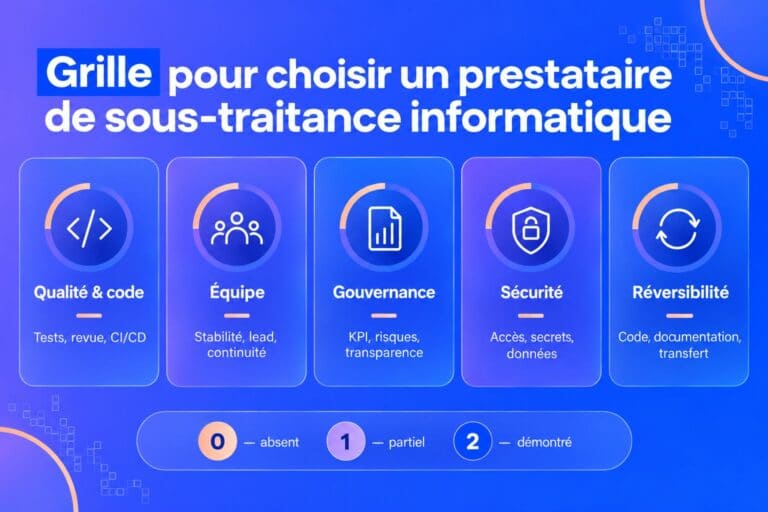
Quality can’t be decreed: it’s built. To secure an offshore IT service, several pillars are essential.
- A robust continuous integration pipeline, with automated tests, code quality checks and security scans.
- Systematic code review, ideally with a local-offshore pair to share standards.
- A testing culture, not just unit tests but also integration, performance and user acceptance testing.
- Living documentation, as close as possible to the code, updated by those who write it.
- Ongoing product dialogue, to avoid the “good code but wrong feature” syndrome.
These fundamentals determine the real value of the custom software you’ll get.
Conclusion: see offshore as an investment, not an expense
The cost of offshore outsourcing is rarely the right starting point. The real question is: “what business value do we want to produce, and which setup – local, offshore or hybrid – allows us to achieve it with the best cost/quality/time ratio?”.
Once this question is asked, the offshore developer’s rate becomes what it should always be: one indicator among others, integrated into an overall analysis of the real offshore cost.
Well-executed offshore is a powerful competitiveness lever, provided you take care of scoping, recruitment, steering and quality. Poorly executed, it becomes a budget trap.
At Etixio, our job is precisely to avoid this trap and turn your offshore IT outsourcing into a lasting competitive advantage. Our teams help you identify the right outsourcing model, the right level of steering and the right budget. Let’s talk about your IT project.
FAQ
How much does offshore outsourcing cost?
The cost depends on the country, the experience level of the profiles, the chosen model, the level of supervision and the complexity of the project. You need to look at the full cost, not just the daily rate.
What are the hidden costs of an offshore project?
The main hidden costs can come from steering, communication, quality rework, delays, insufficient documentation or poor initial scoping.
Is offshore always cheaper than a local team?
Not automatically. Offshore becomes cost-effective when the partner provides the right profiles, a sound methodology, quality monitoring and a clear organization.
How do you calculate the ROI of offshore outsourcing?
You need to compare the savings achieved with the costs of setup, steering, coordination and quality. ROI also depends on the team’s actual productivity.
What is the difference between an offshore developer’s rate and the real cost?
The developer rate is the price of one resource. The real cost also includes project management, onboarding, communication, quality, tools, risks and the ability to deliver on time.
How do you avoid cost overruns with offshore?
You need to scope the need, define clear responsibilities, set up follow-up rituals, measure quality and choose a partner able to handle recruitment, supervision and continuity.