Choosing an offshore outsourcing destination isn’t a geographical decision. It’s a governance decision.
A poor choice doesn’t just mean a few extra bugs. It means:
- technical debt
- rework
- budget overruns
- delayed time-to-market
- loss of internal trust
The real question isn’t: “Where are developers cheapest?”
The real question is: Which destination maximizes my chances of success given my product, my maturity, my working language and my management capacity?
Let’s compare Madagascar and Vietnam through a strategic lens.

What really determines the success of offshore outsourcing
Before talking about countries, let’s talk about mechanics. An offshore project succeeds if four variables are under control:
- Linguistic and cultural alignment
- Real operating window
- Maturity of the delivery system
- Governance on the client side
The country amplifies these variables. It never replaces them.
Madagascar, a lever for proximity and product collaboration
Madagascar is particularly relevant for French-speaking European organizations.
Key strategic advantage
Language fluency. In a B2B SaaS product, a business platform or complex application maintenance, the quality of functional scoping is decisive. A French-speaking environment reduces:
- specification ambiguities
- business misunderstandings
- the cost of rework
Time zone overlap
The time zone allows natural collaboration with Europe. Dailies, grooming, incident management and business workshops stay simple.
Structural limitation
The market is smaller than Vietnam’s. Success depends heavily on:
- the actual level of seniority
- the partner’s ability to structure QA, CI/CD and technical leadership
Madagascar is therefore an excellent choice if:
- your organization is mostly French-speaking
- your product requires strong business interaction
- you’re looking for stability and continuity
Vietnam, a lever for scalability and industrialization
Vietnam has become a major player in offshore software development.
Key strategic advantage
The ability to scale. If you need to:
- double a team in 3 months
- structure several squads
- industrialize multi-product delivery
Vietnam offers a larger talent pool.
Technical ecosystem
Strong exposure to international projects. Good maturity in mobile, DevOps and cloud.
Particularly well suited if:
- your organization works in English
- your documentation is structured
- your governance is already solid
Structural limitation
The time difference with Europe reduces the shared working window. This requires:
- quick decisions
- a very clear backlog
- tightly framed rituals
Madagascar vs Vietnam, the strategic reading in 5 minutes
If your organization looks like this:
- French-speaking CEO and business teams
- Highly involved PO
- Constantly evolving product
- Need for daily proximity
- Significant run and application support
→ Madagascar maximizes fluency and reduces the risk of misunderstanding.
If your organization looks like this:
- English-speaking or international organization
- Solid documentation
- Mature governance
- Need to scale quickly
- Multi-country product logic
→ Vietnam maximizes ramp-up capacity and industrialization.
If you’re in this hybrid situation:
- European product
- International ambitions
- 2 to 3 squads needed
- Run + build at the same time
→ A hybrid architecture can be relevant:
- Run and product collaboration in French with our developers in Madagascar and Mauritius
- For English-language or high-value projects, a support team in Vietnam, working with Mauritius as a single team
The decision isn’t binary. It must be systemic.
The real differentiator isn’t the country, it’s the system
Many offshore failures attributed to the “country” are actually due to:
- no Definition of Done
- no quality KPIs
- unclear governance
- an unsuitable contract model
- confusion between time & materials and a dedicated team
Poorly managed offshore fails everywhere. Structured offshore can succeed in several destinations.
The real risk, then, isn’t geographical. It lies in the maturity gap between your organization and your partner.
When this gap is large, the destination amplifies weaknesses instead of offsetting them.
Real cost: why TCO matters more than the daily rate
The cost of offshore development in Madagascar or Vietnam may look similar. But the CEO needs to analyze:
- turnover rate
- stability of leads
- quality of deliveries
- frequency of bugs in production
- average release lead time
TCO includes:
- poor quality
- technical debt
- rework
- decision latency
A lower daily rate can lead to a higher overall cost over 12 months.
The Etixio method to de-risk the decision
At Etixio, we never start from the country. Most of the difficulties we see in offshore projects don’t come from the destination, but from the lack of structured management. Our main market is French-speaking: our teams are first in Madagascar and Mauritius, with support from Vietnam on some English-language projects. We start from:
- your product
- your organization
- your agile maturity
- your security and GDPR constraints
- your scaling ambitions
Our method:
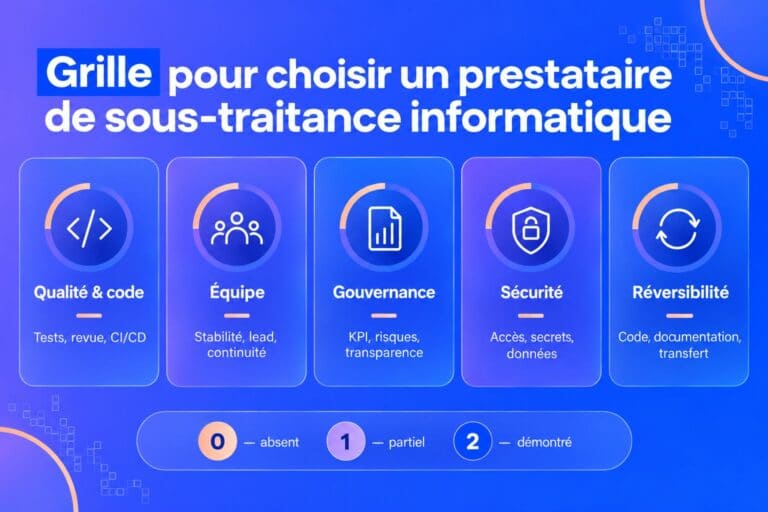
- Quick governance diagnosis
- Assessment of the right contract model
- Destination scoring based on your context
- A structuring Sprint 0
- Setting up delivery and quality KPIs
The goal isn’t to choose Madagascar or Vietnam. The goal is to reduce systemic risk.
Strategic mistakes you must avoid
- Choosing on price alone
- Outsourcing without keeping a strong PO on the client side
- Confusing flexible time & materials with absent governance
- Neglecting access security and GDPR compliance
- Launching a 6-month project without a short pilot
A 1-to-2-week mini-pilot is often the best risk-reduction investment.
FAQ
Madagascar or Vietnam: which destination should you choose for an offshore IT project?
The choice between Madagascar and Vietnam mainly depends on your organization and your product.
Madagascar is particularly well suited to French-speaking environments that require strong business interaction and daily collaboration.
Vietnam, for its part, is often preferred for projects that require a rapid ramp-up and an organization already structured in English.
The best destination is therefore the one that aligns with how you operate, your governance maturity and your delivery objectives.
Is Vietnam better suited to large-scale IT projects?
Yes, Vietnam is often better suited to IT projects that require strong scaling capacity. Its ecosystem makes it possible to quickly build several teams and structure multi-squad organizations.
However, this capacity requires a solid framework: clear documentation, a structured backlog and mature governance. Without it, complexity can increase quickly.
Is Madagascar only suited to French-speaking IT projects?
No, but Madagascar performs particularly well in French-speaking contexts where the quality of business exchanges is decisive. This reduces misunderstandings, speeds up scoping and makes day-to-day collaboration smoother.
In some cases, Madagascar can also fit into international organizations, especially when used as a hub for product collaboration or application run.
Can Madagascar and Vietnam be combined in an offshore strategy?
Yes, a hybrid approach can be relevant in some contexts. For example, Madagascar can be used for product collaboration, application support and business exchanges, while Vietnam can handle ramp-up needs or technical industrialization.
This kind of organization does, however, require clear governance and a sound split of responsibilities to avoid silos.
Which criteria help assess the best offshore destination for your project?
Beyond the country, several criteria are decisive: working language, time zone, delivery maturity, governance capacity on the client side and the level of business interaction required.
These factors must be analyzed together to identify the destination that maximizes your chances of success, rather than relying on cost alone.
How can you de-risk the choice of an offshore destination before committing?
The best approach is to test the setup on a short scope before launching a full project. A mini-pilot or a scoping sprint lets you assess the quality of exchanges, understanding of the need and the partner’s ability to structure delivery.
This step greatly reduces the risk of a gap between the initial promise and operational reality.