Introduction
For a long time, “offshore” was synonymous with shaky projects, endless meetings and disappointing savings. Many offshore IT myths still hold companies back today.
That picture is outdated. Remote work has become the norm, tools have matured, and serious providers now operate with the same level of rigor as your in-house teams. The goal isn’t to “do it cheap,” but to gain capacity and speed while keeping control over the product.
Let’s look at what has really changed, without jargon, with simple examples.

Why the clichés no longer hold up
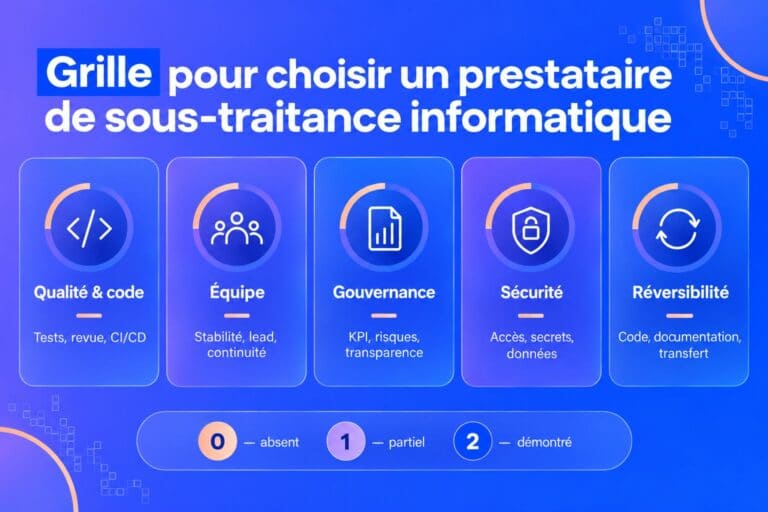
First, a partnership is no longer judged on its “daily rate,” but on what gets delivered: release regularity, code quality, response time when an incident occurs. Next, visibility is no longer a problem: a shared progress board shows task status, priorities and risks. Finally, security is taken seriously from the start: named accounts, limited permissions, strong authentication, separate environments and regular checks.
Another key point: distance doesn’t prevent working well together. You keep 2 to 4 hours of overlapping working time for decisions and important meetings; the rest happens in writing (clear tickets, short reports), which avoids misunderstandings and saves time.
The result: less waiting, fewer meetings, more predictable deliveries.
These offshore IT myths don’t stand up to reality on the ground, as the following examples show.
Three concrete examples
1) E-commerce SMB: getting a second wind without rewriting everything
An online store was dragging along an application “block” that was slow to evolve. Rather than tearing everything down, it gave a small external team a simple goal: extract one feature at a time (for example, promotions management), stabilize it, then move on to the next.
Ground rules: small, frequent releases, automated tests, quick review of every change, and an alert dashboard in production. Within three months, incidents dropped, releases became regular, and the in-house team refocused on product ideas. Here, offshore wasn’t “cheaper”; it was more effective.
2) SaaS vendor: innovating without blocking what already exists
A software vendor wanted to add an AI component without slowing down its main platform. It assigned the exploration (mockups, technical trials, user feedback) to a remote team, with short, dated objectives. As soon as an idea was validated, the core product team took over to integrate it cleanly.
The benefit: fast experiments, low risk and controlled integration. Distance acted as a buffer: you experiment on the side and plug in what works.
3) FinTech scale-up: stabilizing the app without overloading the team
A payments scale-up saw its developers burning out between urgent fixes and new features. It assigned a small offshore team the day-to-day maintenance: bug fixes, small interface improvements, security updates.
A simple organization: a clear queue of topics, small, regular production releases (during the day, with rollback possible) and a short report after each intervention.
Within a few weeks, the incident backlog had plummeted, users complained less, and the in-house team got time back to ship the features people were waiting for. Offshore played its role as a bumper: it absorbs the day-to-day so the core team can move forward.
How to go about it (the bare minimum)
- Start small. 2 to 6 people are enough to test the model without risk.
- Clarify the target. What you want to deliver this month, this quarter, and what “done” means.
- Show the movie, not the snapshot. A simple dashboard showing progress, bugs and lead times.
- Secure things from the start. Named accounts, limited permissions, managed secrets, separate environments.
- Write down the essentials. A 10-line note beats an hour-long vague meeting.
- Stay consistent. A short check-in every day or two, frequent demos, and small but continuous deliveries.
Conclusion
Today’s offshore IT has little in common with the stories of the past. Far from the offshore IT myths, well-structured projects now show concrete results.
Properly scoped, it accelerates, stabilizes and calms your projects: you deliver more often, with fewer surprises, and you stay in control of decisions. The key isn’t distance: it’s the way you work.
Want to try it under the right conditions? We can help you set up a small offshore dedicated team, lay down the simple rules that make the difference and track the real cost (not just the rate).
Share your goals and your context with us: we’ll suggest a lightweight format to get started quickly.