
You have decided to launch a dedicated team. You are told it will start in four to six weeks, and the next question comes quickly: what happens in the meantime, and what is expected from you?
These weeks are not idle time. This is when the developers are chosen, access is prepared and the content of the first working days is decided. It all happens before the engagement starts: billing begins when the team starts working on your product.
Here is how this period unfolds at Etixio, step by step, and what depends on your side.
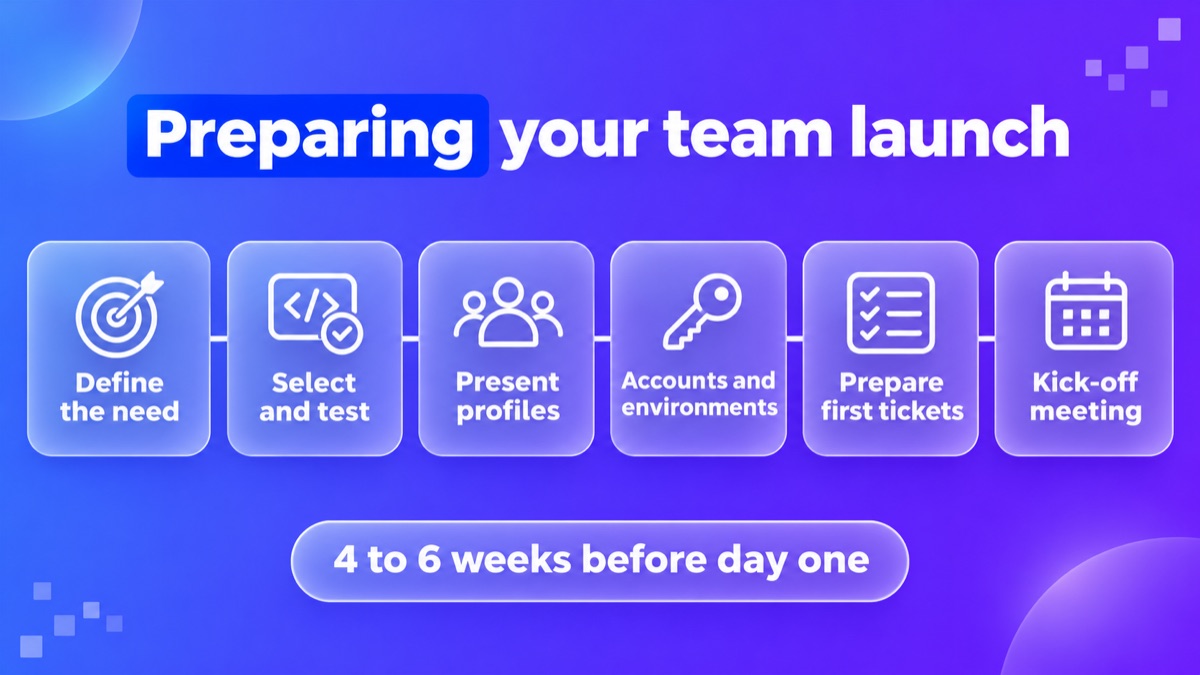
Defining the need
Everything starts with a discussion about your product: what it does, how it is built, what you want to deliver over the next three months. You do not need a detailed specification. A roadmap, even a rough one, the list of technologies in use and what slows you down today are enough.
This discussion produces one brief per role: technologies, level of experience, useful extra skills (testing, DevOps, mobile, AI integration) and a first scope of work. That brief is then used to find and assess candidates. Our article on the profiles of a dedicated team covers the most common setups.
It is also the right time to check the format. A dedicated team suits a product that evolves over time and whose priorities you keep. To hand over an objective to an Etixio project lead, a managed project is a better fit. For a short, fixed scope, choose a fixed-price project instead.
To prepare on your side: a three-month roadmap and the names of two contacts, one for the product and one for the technical side. They will approve the profiles and answer the team’s questions.
Selecting and testing candidates
We look for candidates in Madagascar and Mauritius, based on the role brief. An experienced PHP or JavaScript developer can be found within a few days. A rarer profile, for example a Java developer with banking experience, takes longer.
Each candidate takes a technical test on the project’s technologies, then an interview with one of our tech leads. The test shows how they write code. The interview shows how they reason, explain their choices and communicate. Candidates who do not pass this stage are not presented to you.
One point is often overlooked: a good developer usually already has a job. If selected, they must serve a notice period with their current employer, which can last several weeks. This is one of the reasons why timing varies from one hire to the next.
Presenting the profiles
We then present the shortlisted candidates: their background, their test results and the opinion of the lead who assessed them. You run your own video interview, with whoever you want to involve, and then you decide. No developer joins your project without your approval.
This is the step where the schedule depends most on you. A candidate who waits ten days for an answer has often accepted another offer in the meantime, and the search starts again.
To prepare on your side: interview slots blocked in the week after the profiles are presented, and an answer within forty-eight hours of each interview.
Preparing accounts and environments
While profiles are being approved, we prepare access. It is the least visible part of the preparation, and the one that wastes the most time when it is forgotten: a developer who waits for an account on day one spends the week reading documentation.
The list barely changes from one project to the next:
- Code repositories (GitHub, GitLab or Bitbucket)
- The ticketing tool and existing documentation
- Development and staging environments
- VPN or network access, if your IT policy requires it
- Your team’s messaging and video tools
- Test accounts for third-party services (payment, email sending, business APIs)
We send you this list as soon as the first profile is approved, and we check every access before day one. Accounts are personal and limited to what each person needs: you always know who has access to what, and you can revoke access in a minute.
To prepare on your side: request access as soon as the profiles are approved. A VPN request that needs your security officer’s signature can, on its own, delay a start by a week.
Preparing the first tickets
A team that arrives without a clear task spends its first days waiting. The last week of preparation is therefore used to choose, with your contact, what the team will work on first.
The first tickets are deliberately small: a bug fix, a minor improvement, a missing test. They let the team discover the code and push a first change through the whole pipeline (code review, tests, deployment to staging, approval). This is often when you discover an unstable staging environment or a deployment that only one person knows how to run. Better to find out on a ten-line fix than on a feature your customers are waiting for.
Beyond these first tasks, we prepare with you the work for the first two or three weeks, so the team does not run out of work once it has started.
Preparing the kick-off meeting
The kick-off meeting takes place on day one. We prepare the agenda with you, and the meeting usually lasts half a day:
- Product presentation by your contacts: what it is for, who uses it, how it is built
- Introduction of the team and its Etixio tech lead
- Shared rules: what “done” means, code review rules, tools and channels
- Rituals and hours: daily stand-up, demos, planning
Working hours are easy to align. Antananarivo is two hours ahead of Paris in winter and one hour in summer. Port Louis is three hours ahead in winter and two in summer. A daily stand-up at 9:30 in Paris is 11:30 in Antananarivo in winter, in the middle of the working day. If you already have a method, the team follows it. Otherwise, we propose our way of working.
By the end of the meeting, each developer has their access, their first ticket and knows who to ask.
What makes preparation take four weeks or six
The required profile matters, and that is the part nobody really controls. The rest depends mostly on organization: how fast interviews and decisions happen, whether access is opened before arrival, and whether a contact is available to prepare the first tickets.
When these three points are anticipated, preparation fits within the announced timeframe, even for a team of several people. Our Symfony case study shows an example, with a team that grew from two to eight developers.
Your checklist before day one
- A three-month roadmap and two named contacts
- Interview slots booked, and an answer within forty-eight hours
- Access requests sent as soon as profiles are approved
- Two or three first tickets clarified
- Half a day blocked for the kick-off meeting
After the launch
Our tech leads follow the team from day one: code reviews, standards, regular check-ins with your technical contact, as set out in our commitments. A first review after a few weeks helps adjust the team’s composition or organization. Our article on governing an offshore IT team details the indicators to track next.
Discover our dedicated team offer or talk to us to prepare your team’s launch.
Launch a dedicated offshore team: frequently asked questions
How long does it take to launch a dedicated offshore team?
Usually four to six weeks between the decision and the team’s first working day. The time mostly depends on how rare the required profiles are, on candidates’ availability and on how quickly you give feedback after interviews.
Is the preparation period billed?
No. Preparation (defining the need, selecting profiles, tests, interviews, setting up access) comes before the engagement starts. Billing begins when the team starts working on your product.
Do I take part in choosing the developers?
Yes. We assess each candidate technically before presenting their profile, then you run your own interview and decide. No developer joins your project without your approval.
What most often makes preparation take longer?
A rare profile, late feedback after interviews, and access that is not ready on day one. The last two depend on your organization and are easy to fix when anticipated.
Can we start with a single developer?
Yes. Many teams start with one or two developers and then grow. Later arrivals benefit from the preparation already done and get up to speed faster.