Bring the record together
Combine into a single view information scattered across record data, clinical reports and related documents.
Case study · Leading hospital
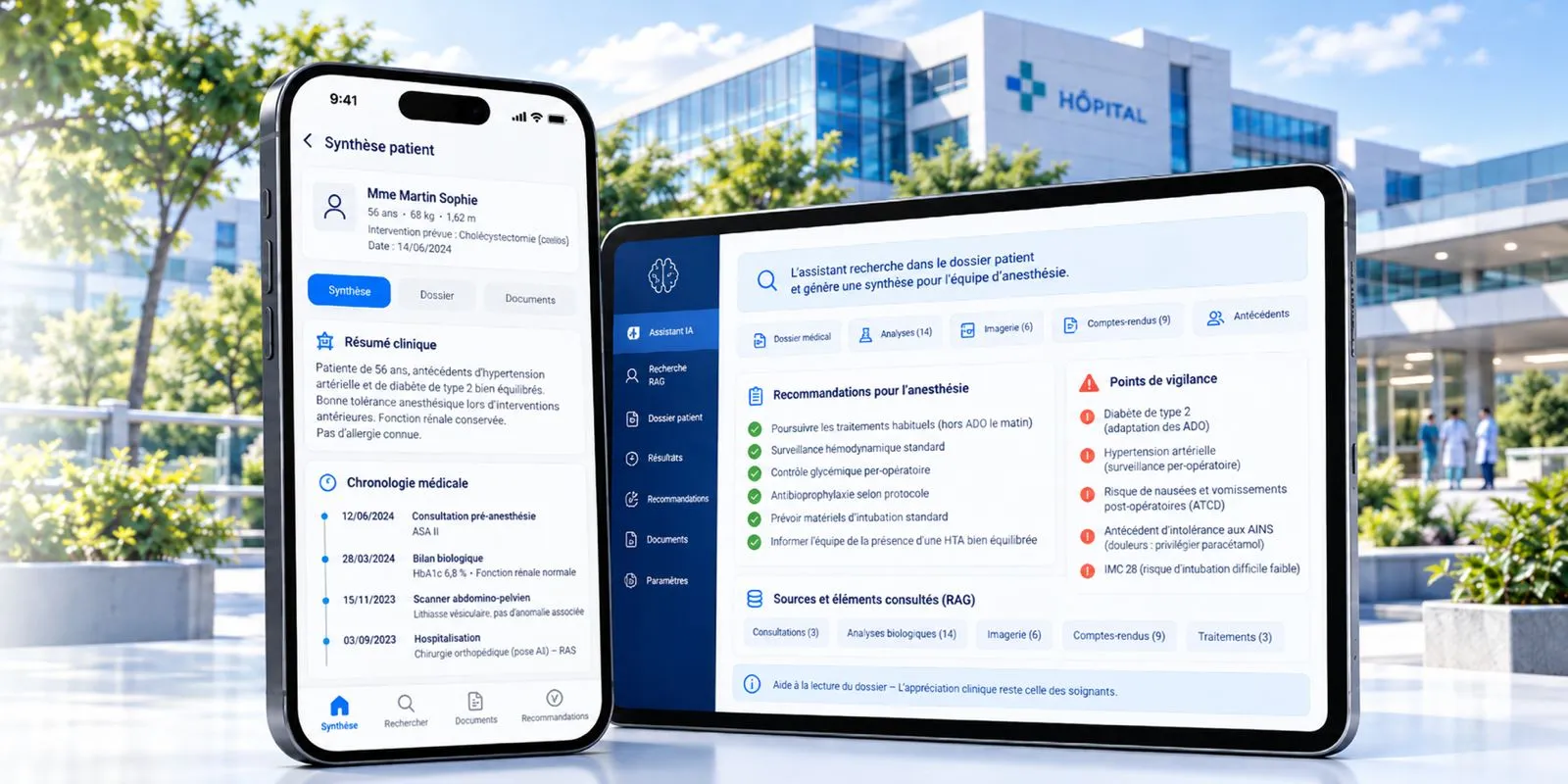
A medical AI agent that retrieves information from the patient record and presents it to anesthesia teams as a chronological summary. We designed and built the RAG-based assistant and the interface that makes it available to medical teams. It supports reading the record; clinical judgment stays with the clinicians.
Leading hospital
RAG assistant and review interface
Support for reading and summarizing the record
RAG, large language models (LLMs), business application
The client
A leading hospital wanted to make things easier for its anesthesia teams when preparing a consultation.
The information they need exists, but it is spread across record data, clinical reports and documents from the patient journey. Bringing it together takes time, especially with large records.
The challenge
Combine into a single view information scattered across record data, clinical reports and related documents.
Present information chronologically, for a more direct read before the pre-anesthesia consultation.
Every item in the summary must come from the record, not from the model’s general knowledge.
Cut the time spent looking for information in large records.
Medical record data and related documents.
Retrieval of relevant passages and organization of the information.
The patient journey presented in a dedicated interface.
What we built
We designed and built the entire service, from retrieval in the record data to the screen the teams use. The assistant is not an isolated demo: it is connected to an application designed for the way medical teams work.
A RAG-based assistant that finds the relevant passages in the record data and documents.
Chronological organization of the patient journey.
A review interface that makes the summary available to anesthesia teams.
Health data and evaluation
An assistant that reads patient records processes health data. On this kind of project, we work to the following principles, defined with the hospital and its teams (IT, data protection officer, clinical leads).
The assistant only accesses the information needed for the expected summary.
Only authorized clinicians can view the summary, according to the hospital’s access rules.
The solution runs on a secure server certified for health data hosting (HDS, the French certification for health data hosts). Logging and retention periods are defined with the hospital, in line with the regulations that apply to health data.
Check the summary’s faithfulness to the sources and look for omissions on reference records reviewed by clinicians, before every change.
The assistant helps read and summarize. It makes no diagnosis and no recommendation; the decision stays with the clinicians.
This is the approach described in our LLMOps and AI evaluation expertise and in our article on AI precautions, risks and compliance.
Team and organization
The project was delivered as part of an “AI agents” engagement by a dedicated team, the way we deliver: engineers who design, build and evolve the service as the medical teams’ needs emerge.
The same team covers document retrieval, model integration and application design. It therefore understands both how the AI behaves and the screen clinicians use to consult it.
Technologies used
RAG (retrieval-augmented generation) grounds the summary in the patient’s documents rather than in the model’s general knowledge. Relevant passages are first retrieved from the record, then a large language model (LLM) organizes them into a chronological summary.
The architecture connects three building blocks: access to record data, document retrieval and summary generation, exposed through a business interface. It is the same kind of work we do in our RAG development and AI agent projects.
Outcome
This project shows what we do with AI: connect existing data to a concrete use, then build the software that makes that information usable. We apply the same approach in-house with Bobby, our AI assistant connected to our ERP.
Frequently asked questions
It retrieves information from a patient’s medical record and presents it as a chronological summary, in an interface built for anesthesia teams. It makes the record easier to read and prepare.
No. It supports reading and summarizing the record. The assistant makes no diagnosis and no recommendation; clinical judgment and decisions remain with the healthcare professionals.
RAG grounds the summary in the patient’s documents. The assistant first retrieves the relevant passages from the record, then the language model organizes them. The summary stays tied to the record’s sources. See our RAG development expertise.
Through principles defined with the hospital: data minimization, access limited to authorized clinicians, hosting on a secure HDS-certified server, and logging and retention in line with the regulations that apply to health data.
On reference records reviewed by clinicians. We check faithfulness to the sources, omissions and readability, and we repeat this evaluation before every change. See our LLMOps and AI evaluation expertise.
Yes. That is what our enterprise AI solutions and AI agents are for: connecting a model to your document sources, building the application around it and supporting the production release.
Tell us about your users, your software and what you want to build or improve.