When to choose offshore IT time & materials is a key question for any organization that wants to accelerate delivery without losing control.
Outsourcing on an offshore time & materials basis is often seen as a simple solution: add developers to speed up a project. In practice, it is a structuring decision that directly affects your ability to deliver, maintain quality and control your costs.
In shifting product environments, where roadmaps change quickly, time & materials brings valuable flexibility. But if it is poorly framed, it can quickly drift: an accumulation of profiles, loss of control, technical debt, soaring rework.
So the challenge is not only knowing whether you should outsource, but when to choose offshore time & materials, under what conditions and with what level of structure.
In this article, we offer a clear framework for deciding: use cases, profiles, budget, governance and, above all, the major pitfalls such as the illusion of low-cost time & materials, particularly when it comes to building a dedicated offshore team suited to your context.

Offshore IT time & materials: capacity or delivery system?
Many companies think they are buying time. In reality, they are buying a software production system.
Two approaches coexist:
- adding resources to produce code
- building a structured team capable of delivering value
The difference is decisive.
In the first case:
- velocity is unstable
- dependencies explode
- technical debt accumulates
In the second:
- quality increases over time
- predictability improves
- costs are better controlled
An effective offshore time & materials setup therefore relies on:
- a structured team
- a clear delivery framework
- results-oriented management
Without this, geographic distance amplifies misalignment.
Offshore IT time & materials: definition, how it works and concrete cases
What “offshore time & materials” means (in practice)
Time & materials consists of integrating external profiles into your organization, generally billed at a daily rate, while keeping control over priorities.
But an effective offshore time & materials setup is not limited to supplying developers.
It includes:
- rigorous selection
- structured onboarding
- hands-on management
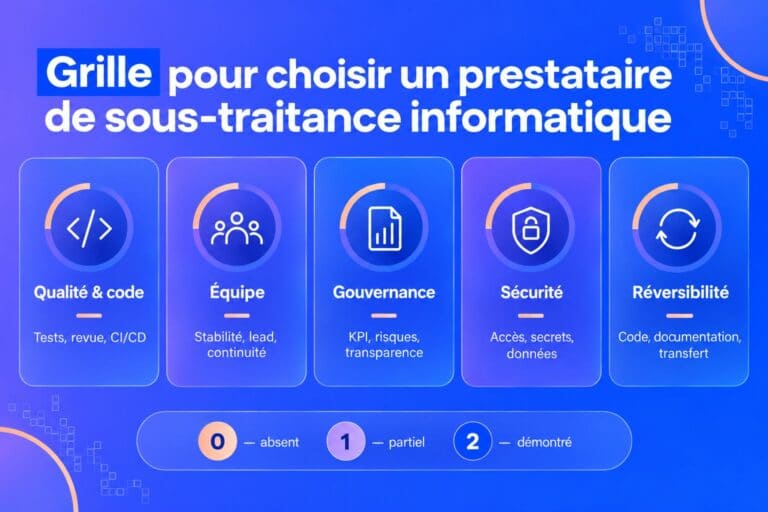
- a quality framework (tests, CI/CD, reviews)
Without these elements, you are not buying a team. You are buying uncertainty.
Time & materials vs fixed-price vs staff augmentation: the real trade-off
- Time & materials: maximum flexibility, managed by the client
- Fixed-price: frozen scope, risk borne by the provider
- Staff augmentation (a commonly used term): close to time & materials, but sometimes more “isolated resources” than “structured team.” The challenge is to avoid adding profiles without governance.
Time & materials becomes relevant as soon as:
- the scope evolves
- complexity increases
- the product requires continuity
More broadly, it is part of a structured IT outsourcing strategy, where the choice of delivery model is a key performance lever.
Projects that are truly suited to time & materials
Offshore time & materials is particularly well suited if you have:
- an evolving roadmap
- a growing product
- a legacy system to take over gradually
- multiple dependencies (data, information systems, security)
- a long-term capacity need
When to choose offshore IT time & materials (and when to avoid it)
7 signs that time & materials is the right option
Knowing when to choose offshore IT time & materials depends directly on your product context, your level of uncertainty and your management capacity.
- you know where you’re going but not yet how
- your backlog changes continuously
- you need to deliver fast and often
- you need to scale gradually
- some skills are hard to recruit
- you are truly working in agile
- you want to build long-term value
5 cases where time & materials is a bad option
- frozen, fully specified scope
- one-off need
- no management on the client side
- a fixed price is the top priority
- an immature organization
Quick decision matrix
- high uncertainty + need for speed → time & materials
- low uncertainty + stable scope → fixed-price
- in-between → framed time & materials with milestones
Low-cost offshore IT time & materials: why it’s a false saving
Comparing daily rates and picking the cheapest gives the impression of optimizing costs. In reality, it is often the opposite.
What many companies discover too late: low-cost time & materials doesn’t reduce costs, it shifts them.
An under-structured setup leads to:
- no QA → bugs in production
- no Tech Lead → technical inconsistencies
- lack of standards → technical debt
- weak supervision → product misalignment
Consequences:
- massive rework
- longer lead times
- extra workload on the client side
- loss of business trust
A setup that is 20% cheaper can generate 2 to 3 times more real cost.
The real indicator is not the daily rate.
It is the ability to deliver quickly, cleanly and without rework.
Which profiles to include in offshore IT time & materials (and how to structure them)
Essential profiles
- developers (front end, back end, full stack)
- QA / test automation
- DevOps / platform
- Tech Lead
- PO / BA (depending on context)
The Tech Lead is often the most underestimated performance multiplier.
Accelerator profiles
- SRE
- Data engineer
- SecOps
- UX/UI
Building a coherent team
An effective time & materials setup relies on a squad model:
- 3 to 4 developers
- 1 QA
- 1 Tech Lead
Without this structure, you are managing individuals. Not a system.
Offshore IT time & materials budget: how to estimate the real costs
What to include
A serious time & materials budget is not just “daily rate × days.” Think about:
- Billed capacity: daily rate × number of days × number of profiles.
- Ramp-up: 2 to 4 weeks depending on complexity (onboarding, codebase).
- Management & quality: TL, reviews, coaching, standards, QA.
- Tools: licenses (Jira, CI, monitoring), environments.
- Rituals: coordination time (necessary, not a “wasted cost”).
Sample budgets (1–3–5–10 FTE) and what changes
- 1 profile: useful to fill a gap, but risk of isolation (dependency).
- 3 profiles: the start of a team dynamic, requires a strong framework on the client side.
- 5 profiles: a real squad, good velocity, more stable management.
- 10 profiles: several streams, governance essential (RACI, KPIs, release train).
What really makes offshore costs vary
Madagascar and Mauritius are two widely used destinations for French-speaking and international IT outsourcing. Daily rates vary according to:
- actual seniority
- tech stack
- level of English
- level of structure
- presence of QA / TL / local manager
Madagascar vs Mauritius: the right choice depends on your operational constraints, not just on cost.
Managing offshore IT time & materials: methods and key KPIs
Essential rituals
- daily: team alignment
- weekly: managing priorities
- review: validating value
- steering: overall vision
Useful KPIs
- lead time
- deployment frequency
- bugs in production
- predictability
- business satisfaction
Risk management
- dependence on individuals
- turnover
- technical debt
- security
An unmanaged time & materials setup always drifts.
Offshore IT time & materials contract: legal framework and best practices
What a good time & materials contract really needs to cover
A time & materials contract should not be a bureaucratic monster, but it must secure the critical points:
- scope of work (and change management)
- billing terms (daily rate, days, absences, on-call duty)
- roles and responsibilities (RACI)
- management arrangements (rituals, reporting)
- intellectual property
- confidentiality and security
The goal is not to lock everything down, but to avoid gray areas.
SLAs, security and quality requirements
Even under time & materials, it makes sense to define:
- commitments on profile availability
- replacement lead times
- quality standards (tests, reviews, CI/CD)
- incident management
A time & materials setup without a quality framework quickly becomes unpredictable.
Reversibility and continuity
This is an often overlooked point.
A healthy setup must provide for:
- up-to-date documentation
- runbooks
- onboarding procedures
- knowledge transfer
Without reversibility, you create a strong dependency.
Onboarding an offshore IT time & materials team: method and best practices
The first 10 days
- Days 1–2: access, environments, repo, CI, tools, functional onboarding.
- Days 3–5: first tickets, shadowing, guided review, coding standards.
- Days 6–10: gradual autonomy, stable rituals, first demo, feedback.
Minimum technical foundation
- clean versioning
- CI/CD
- tests
- observability
Communication
- written decisions
- a clear definition of done
- regular feedback
Offshore IT time & materials: common mistakes to avoid
Confusing time & materials with full delegation. Without management, performance collapses.
Underestimating the role of the Tech Lead. Without a TL, technical debt becomes structural.
Managing by time spent. Time consumed is not an indicator of value.
The Etixio approach: building a high-performing offshore IT time & materials setup
At Etixio, time & materials is not about supplying resources.
It is a structured setup.
Our approach relies on:
- demanding selection of profiles
- organization into a coherent team
- a Tech Lead in every team
- QA integrated from the start
- management based on concrete KPIs
- structured onboarding
Objective: turn time & materials into a reliable, predictable delivery system.
Offshore IT time & materials: an effective solution if it is structured
Offshore IT time & materials is a powerful lever for flexibility and acceleration. But it only works if it is designed as a complete system, not as a simple sum of resources.
The real challenge is not cutting costs in the short term, but building a reliable delivery capacity.
That is precisely what sets an effective time & materials setup apart from a low-cost one.
Next step
Are you considering offshore time & materials or looking to secure an existing setup?
We can help you frame your organization, structure your team and secure your delivery, in particular through an audit of your current setup.
FAQ
IT time & materials: what exactly is it?
IT time & materials consists of integrating one or more external resources (developer, QA, DevOps, Tech Lead…) into your organization, generally billed at a daily rate.
You keep control over priorities (backlog, roadmap), while the team delivers continuously according to your standards.
An effective time & materials setup is not limited to supplying profiles: it includes a delivery framework (rituals, CI/CD, code reviews, quality) and structured management.
Which profiles are most in demand under time & materials?
The most common profiles are:
- full-stack developer
- QA / test automation
- DevOps
- Tech Lead
- PO / PM for management
In practice, the best performance lever is often adding a Tech Lead and a QA engineer. They greatly reduce rework, improve quality and stabilize velocity.
What budget should you plan for a time & materials team?
The budget depends on the daily rate, the number of profiles and the duration.
But a realistic calculation must include:
- ramp-up (onboarding)
- governance time (rituals, coordination)
- the technical foundation (CI/CD, testing, monitoring)
The right approach is to think in terms of monthly capacity (FTE) and delivery objectives, rather than days consumed.
What is the daily rate for a developer in Madagascar or Mauritius?
Daily rates vary according to several factors:
- actual seniority
- tech stack
- level of English
- level of structure (presence of QA, TL, processes)
Comparing daily rates alone is misleading. A cheaper standalone developer can end up costing more than a structured team, because of rework and quality defects.
Madagascar vs Mauritius: which destination should you choose for offshore IT time & materials?
Madagascar offers an excellent cost-to-skills ratio, with a fast-growing IT ecosystem. It is particularly well suited to setting up structured offshore squads for build and run.
Mauritius is more internationally oriented, with strong English-speaking exposure and an environment often preferred for multi-country contexts or frequent interaction with global teams.
The right choice depends less on the country than on your operational context:
- working language
- time zone
- level of criticality
- need for seniority and stability
Can you start with time & materials and then switch to fixed-price?
Yes, it is a common strategy.
- Time & materials helps clarify the need, stabilize the architecture and reduce uncertainty.
- Then, certain work packages can be outsourced on a fixed-price basis.
Many organizations keep a core team on time & materials and “package” specific projects.