For a long time, the offshore IT services model was mainly seen as a cost optimization lever. This approach helped many companies accelerate their IT projects, but today it is showing certain limits.
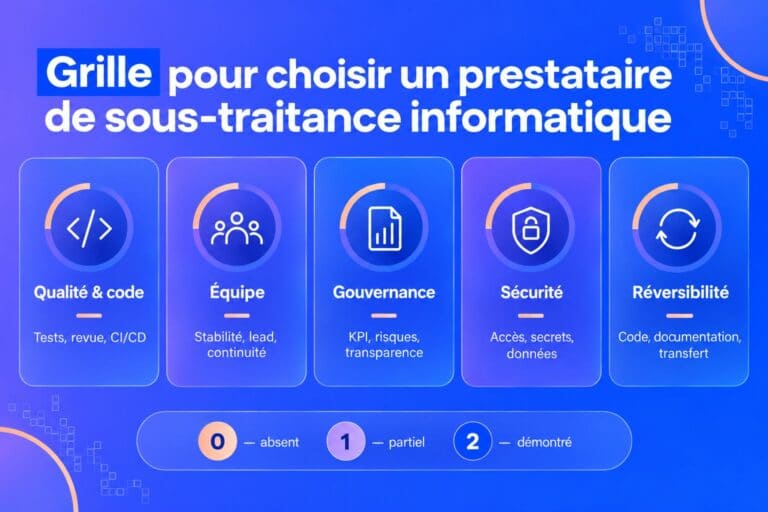
CIOs now face other challenges: tight tech recruitment, accelerating transformation projects, operational continuity, team stability and the ability to maintain quality over time.
In this context, offshore IT is gradually shifting from a cost-reduction logic to one of execution capacity and long-term integration into companies’ organizations.
After more than ten years in IT outsourcing, it is precisely this market shift that led us to return to the world of offshore IT services with Etixio, built around a different model.

The traditional offshore model is showing its limits
For years, part of the offshore market was built on an essentially financial logic: producing faster and cheaper.
This model helped many companies accelerate their projects. But it also created limits that CIOs now clearly recognize:
- high team turnover
- dependence on a single delivery location
- lack of project governance
- difficulty maintaining quality over time
- poor team continuity on long projects
Many CIOs no longer question the principle of offshore itself. However, they are becoming much more demanding about how it is structured and managed over time.
What CIOs now expect from an offshore partner
IT departments’ expectations have changed significantly in recent years.
This shift is driven in particular by structural tensions in the IT market. Recruitment difficulties, accelerating transformation projects and pressure on timelines now make production capacity a far more critical issue for CIOs.
IT system modernization, cloud, data, AI, cybersecurity: roadmaps keep accelerating even as experienced people become harder to recruit locally.
In this context, offshore IT development outsourcing is becoming less a matter of budget optimization and more a matter of execution capacity and operational continuity.
Many companies are no longer simply looking for a provider that can deliver quickly. They are looking for organizations able to integrate durably with their business challenges and the way they operate.
Today, CIOs are looking for:
- teams that can ramp up quickly
- better integration with in-house teams
- more visibility on quality and governance
- organizations able to support projects over the long term
This is especially true in IT modernization, cloud, data or AI contexts, where projects run over the long term and require strong team continuity.
Why we chose to return to the offshore market
After more than ten years in the world of offshore IT services, a question naturally arose: should we return to this market?
For Julien Goumet and Mathieu Bernard, who had already spent more than a decade supporting French companies on offshore software delivery and IT team structuring, the answer was yes, but only by building a different model.
This new phase was also an opportunity to step back and consider what we really wanted to rebuild.
Over the years, this experience gave us a better understanding of CIOs’ expectations, governance challenges and the limits some offshore models eventually run into when they rely on an overly centralized or purely cost-driven logic.
Their complementary profiles have largely shaped Etixio’s vision. Julien Goumet brings experience in building and running large-scale offshore organizations, while Mathieu Bernard focuses more on technical structuring, delivery and operational continuity.
Selling our previous company was not an end. Above all, it was an opportunity to honestly reassess what worked, what needed to change and what we wanted to build differently.
It is precisely this reflection that led to the creation of Etixio: building a more mature offshore organization, designed around team stability, operational continuity and long-term integration with IT departments.
A model based on a structured offshore organization
We chose an organization designed to avoid dependence on a single delivery location, relying on integrated offshore teams managed from France within an integrated offshore organization. These French-speaking engineering teams are based in Madagascar and Mauritius.
In particular, this approach makes it possible to:
- avoid dependence on a single delivery location
- adapt teams to each client’s context
- guarantee the same level of follow-up, quality and governance over time
Each engagement is governed by common standards for management, quality monitoring and collaboration with client teams.
The goal is not to multiply locations. The goal is to build an organization able to secure operational continuity over the long term.
Our employee pact as a driver of lasting quality
The quality of an offshore organization rarely depends solely on the technical level of its teams. It also depends on their stability over time.
In offshore IT, turnover is not just an HR issue. It directly affects project continuity, knowledge transfer and the ability to maintain a lasting level of quality.
That’s why at Etixio we have structured an employee pact based on:
- pay above local standards
- continuous training
- internal career paths
- sustainable working conditions
- a long-term retention approach
This approach represents a significant investment. But we are convinced that a sustainable offshore model cannot be built on cost optimization alone.
Toward a more mature offshore model
Looking at the offshore IT services market, two models often dominate: very large, highly industrialized organizations, and smaller ones that sometimes struggle to offer the level of operational continuity and governance CIOs expect.
For a long time, offshore models were mainly assessed through the lens of cost. This approach is now reaching certain limits.
Companies now expect organizations able to bring more stability, visibility and continuity over time, especially on critical, long-term projects.
We believe that CIOs’ current expectations are creating room for offshore models that are more structured, more closely aligned with business challenges and built to last.
This is precisely the direction we wanted to give Etixio: building an organization able to combine sustainable delivery, team stability and long-term governance.
Let’s talk about your offshore IT organization
At Etixio, we regularly talk with CIOs and technical leaders facing challenges in structuring offshore teams, ensuring project continuity or scaling up on critical projects.
Are you thinking about structuring or evolving your offshore IT organization?
Let’s discuss your context and how a structured offshore model can integrate durably into your organization.
Every company has its own constraints, delivery challenges and level of maturity. The goal is not to apply a single model, but to build an organization suited to the operational realities of each context.
FAQ
Is the offshore model still relevant today?
Yes, but expectations have changed. Companies are no longer looking only for cost optimization. They now expect more stability, governance and operational continuity.
The market is moving toward offshore models that are more mature and more closely aligned with CIOs’ challenges.
What are the key criteria for structuring a sustainable offshore organization?
The most important criteria generally concern team stability, quality of governance, operational transparency and the ability to maintain a high level of quality over time. The ability to integrate with in-house teams is also becoming a key factor.
Why are multi-location offshore models growing?
Multi-location models reduce dependence on a single delivery location and improve operational continuity. They also offer more flexibility to adapt teams to project contexts and company constraints.
What sets Etixio apart from other offshore IT services companies?
Our approach rests mainly on three convictions: team stability as a key driver of quality, governance designed for the long term, and a lasting partnership with CIOs rather than simply supplying resources.