A CTO considering offshore often has the same barely admitted concern: once the contract is signed, will quality collapse because the team is 8,000 kilometers away?
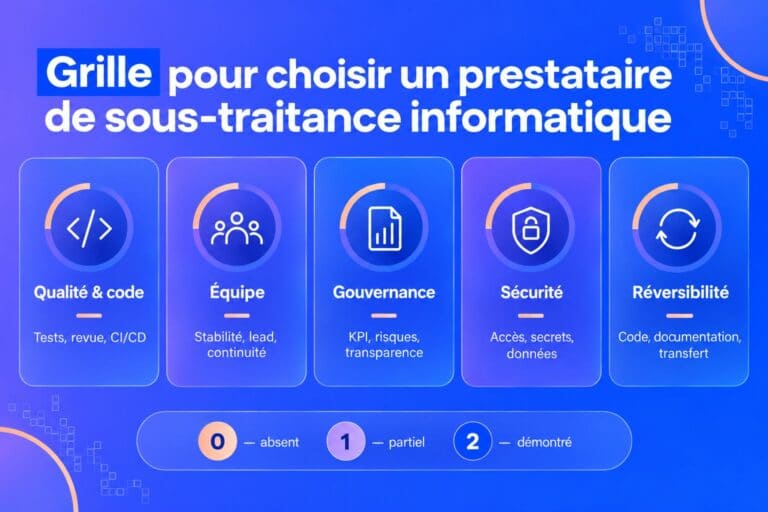
Yet the quality of an offshore project does not depend solely on the country chosen. It rests above all on four pillars:
- a structured QA approach;
- automated checks through CI/CD;
- regular code reviews;
- transparent project management.
We’ve all heard the story of a project that went off the rails: untested code pushed to production on a Friday evening, patchy communication or a schedule that slips until the budget blows up. These situations exist, there’s no point pretending otherwise. But they are not a story about Madagascar: they are above all a story about missing or poorly applied processes. And that can happen just as easily 200 meters from your headquarters as on the other side of the world.
At Etixio, we have built our way of working to limit precisely these risks. Not with a miracle method, but with concrete mechanisms applied throughout the project.
In this article, we look at how QA, CI/CD, code review and project management secure the quality of an offshore development project in Madagascar.

Madagascar and offshore development: why does mistrust persist?
Let’s be honest for a second. Offshore has a two-tier reputation. On one side, companies that have had great experiences, with teams that saved impossible deadlines. On the other, executives burned by a provider that delivered code that looked functional but was riddled with technical debt, invisible until the day everything breaks.
The difference almost never comes down to the time zone or the team’s nationality. It comes down to the rigor of the framework: are there automated tests or not? Does a second developer review every line before it goes to production? Does the client know at all times where the project stands, or do they have to wait for a vague email on Friday evening to get a rough idea?
In Madagascar, there is a pool of well-trained, curious engineers, often bilingual and used to Western agile methods. It is no coincidence that the island is attracting more and more IT services companies and tech businesses looking for solid value for money without sacrificing rigor. But the talent pool alone is not enough. What really secures a project is the infrastructure of trust built around it: the processes. That is what we will detail, building block by building block.
How should QA be structured in an offshore project?
Let’s be direct: QA is not a step you add at the end to “check that it works.” For us, it runs through the entire development cycle, from writing the specs to the production release. A developer who writes a feature without thinking about edge cases, user errors and unexpected behavior simply doesn’t exist in the way we work, and it’s not a question of individual talent, it’s a question of team culture.
In practice, every feature goes through several layers of testing before it is considered done. Unit tests that check that each building block of code does exactly what it is supposed to do, in isolation. Integration tests that make sure those blocks, once assembled, don’t step on each other. And functional tests, often manual on critical user journeys, because an algorithm cannot yet fully replace the human eye when it comes to user experience.
What really makes a difference is that we document everything. A detected bug is never just “fixed on the side”: it becomes a permanent test case, so that it never comes back to haunt the project. This is called regression testing, and it is probably the element most underestimated by teams that haven’t yet suffered from a bug that comes back three times because nobody took the time to lock it into the tests.
For a CFO reading this and thinking “all of this has a cost,” the answer is simple: yes, it does. But it is a tiny cost compared with that of a critical bug discovered in production a month after launch, when your customers are already venting on social media.
Offshore CI/CD: automating tests and securing deployments
There is a stubborn misconception that speed and safety are incompatible, and that delivering fast necessarily means cutting corners. That’s wrong, and it is precisely the problem that CI/CD, continuous integration and continuous deployment for those discovering the acronym, is designed to solve.
The idea is simple to explain, even if it is technical to implement: every code change automatically triggers a series of checks. Compilation, automated tests, static code analysis to detect security flaws or bad practices. If even one of these steps fails, the code goes no further. No discussion, no exception “just this once because we’re in a hurry.” The machine has no feelings, and that is exactly what we ask of it.
This automated pipeline fundamentally changes the dynamics of a project. Instead of waiting for a “big delivery” every two months, with its share of anxiety and unpleasant surprises at deployment time, you move forward in small increments that are continuously tested and validated. A deployment becomes a non-event rather than a risky operation planned for a weekend with fingers crossed.
For you, on the client side, this translates very concretely: you see your product progress week after week, you can test intermediate versions and give feedback early, rather than discovering three months later that the application is nothing like what you had in mind. It is also, let’s admit it, a way of protecting you from ourselves: nobody is immune to misinterpreting a need, but the earlier the feedback comes, the cheaper the correction.
Code review: improving code quality and maintainability
Here is a practice that seems obvious on paper and yet is rushed in an alarming number of teams, offshore or not, for that matter. The principle: no code is merged into the main codebase without another developer having read it, understood it and challenged it if necessary.
Why is it so important? Because a developer alone in front of their screen, however good, has blind spots. They know their solution, they built it, and they no longer see the shortcuts they took because those feel natural. An outside eye spots what the author no longer sees: a potential security flaw, an architecture that will get stuck in six months when the product needs to scale, a badly named variable that will make maintenance a nightmare for whoever takes over this code in a year, maybe you, maybe another provider, it doesn’t matter.
We insist on this because it is also a matter of knowledge transfer. When two people have looked at every part of the code, you are never held hostage by a single developer holding “the secret” of your application. It is a guarantee of continuity whose importance many executives only discover the day their star developer quits without notice.
And no, it is not a waste of time that slows down delivery. It is actually the opposite in the medium term: a bug caught in review takes a few minutes to fix. The same bug caught three weeks later, in production, costs hours of investigation, an emergency fix and sometimes a client’s trust. Do the math, it adds up fast.
How do you manage an offshore development team in Madagascar?
Geographic distance is often the first mental obstacle raised with us. How can you be sure the project is moving forward when you can’t pop your head around the office door to ask “so, where are we?”
The answer comes down to a word that may be a bit overused in the working world, but that keeps its full meaning here: transparency. In practice, that means regular meetings at times that take the time difference into account (Madagascar is only two hours apart from Paris, by the way, which makes things considerably simpler than with a team based in Asia or South America). It means a project dashboard accessible at any time, where you can see exactly what is in progress, what is done and what is blocked.
We work with an agile method: short sprints, continuous prioritization of tasks, regular demos of the work completed. It’s not a buzzword we stick on our sales brochures: it’s a framework that gives you the power to adjust the project along the way, rather than discovering the final result once everything is set in stone. A developer or CTO who manages an external team knows how much this visibility changes everything in a relationship of trust.
And then there is the aspect that is rarely mentioned: project management also means knowing how to say no, or to say “careful, this deadline isn’t realistic” before it becomes a problem, rather than agreeing to everything to please and delivering three months late. We prefer an uncomfortable discussion in week two to a disaster in week twelve.
Why does offshore quality depend more on processes than on the country?
We won’t hide behind false modesty: Madagascar has a pool of developers and engineers trained in the technologies used by European companies, particularly in web, mobile and software development and in quality assurance.
The island’s computer science schools produce solid developers, often trained in the same frameworks, languages and methodologies as their European counterparts. Being French-speaking makes exchanges with French, Belgian or Swiss companies much easier: no language barrier, no cultural misunderstanding adding to the technical complexity.
What we see, year after year, is that the quality gap between a well-structured Malagasy team and an equivalent European team has nothing to do with geography. It depends solely on the processes put in place. And that is precisely where we chose to build our difference: not on price alone, even if, yes, the cost-to-skill ratio remains a solid argument for many SMBs and freelancers who can’t match Paris rates, but on the methodological rigor that reassures a CTO or CFO when it’s time to sign.
Because ultimately, what you are buying when you work with us is not just development time. It is a guarantee that this time will be well spent, tracked, verified and delivered within a framework where errors are caught early rather than discovered late.
A project that stands the test of time is built now
We could tell you that securing an IT project comes down to ticking boxes: testing, CI/CD, review, project management. It would be easier to sell, but it would be a bit of a lie. The truth is that these four pillars are worth nothing in isolation. What makes the difference is the discipline with which a team maintains them, day after day, even when no one is watching, even on the most thankless task of the sprint.
That is the bet we make at Etixio from Madagascar: proving, project after project, that geographic distance was never the real risk. The real risk was always the lack of method. Do you have a project that deserves better than development in the dark?
Let’s talk about it, with no commitment. We prefer an honest conversation about your needs to a sales promise we couldn’t keep.
FAQ
Why outsource your software development to Madagascar?
Madagascar allows French-speaking companies to strengthen their development capacity while maintaining smooth collaboration with their in-house teams. The country brings together several advantages:
- French-speaking developers;
- a limited time difference with France: one hour in summer and two hours in winter;
- costs that are generally more competitive than in France;
- a pool of skills in web, mobile and software development and in quality assurance.
Outsourcing to Madagascar can meet different needs: accelerating a project, filling a missing area of expertise or building a dedicated development team.
How do you guarantee the quality of an offshore development project?
Quality depends less on where the team is located than on its organization and the processes in place. The project should in particular rely on:
- clearly defined requirements and acceptance criteria;
- regular code reviews;
- tests suited to the project’s risks;
- accessible technical documentation;
- shared follow-up between the client and the development team.
At Etixio, the methods, tools and level of control are defined according to the technical environment, the maturity of the project and the client’s requirements.
How do you keep track of a development team based in Madagascar?
Follow-up relies on shared tools, regular exchanges and short work cycles. The client thus retains visibility on:
- tasks in progress and completed;
- project priorities;
- any blockers;
- developments awaiting validation;
- next steps.
Follow-up meetings and demos can be organized at every sprint. The client remains involved in key technical decisions and keeps access to the code, the documentation and the project tools.
How do you protect code and data in an offshore project?
Protecting code and data must be planned from the project scoping stage. Depending on the context, it may include:
- confidentiality commitments;
- individual management of access rights;
- private code repositories;
- secure authentication;
- separation of development, test and production environments;
- access limited to only the resources each team member needs.
Requirements related to sensitive data, hosting and production releases are defined with the client before the project starts.
What checks should be carried out before releasing software to production?
Before releasing software to production, several manual and automated checks can be carried out depending on the project’s requirements:
- code review by another developer;
- functional validation of changes;
- testing of critical user journeys;
- regression testing;
- review of any anomalies detected.
These checks make it possible to verify that the software meets the criteria defined with the client and that new changes do not disrupt existing features.
What is CI/CD used for in a software development project?
CI/CD automates part of the integration, testing and deployment of code. With each change, a pipeline can in particular:
- check that the code compiles correctly;
- run the automated tests;
- analyze code quality and security;
- prepare or trigger a deployment to a test or production environment.
CI/CD thus makes it possible to detect errors earlier, make production releases more reliable and ship new changes more regularly.