Several countries now make it possible to work in French with a development team: Madagascar and Mauritius in the Indian Ocean, Morocco and Tunisia in North Africa, and Senegal in West Africa, along with other French-speaking African countries whose tech ecosystems are growing. None of them is “the best” in absolute terms. The right choice depends on your working language, the time difference you can accept, the talent pool you need, your budget and, above all, how the team will be managed.
This article sets out the selection criteria, presents the strengths of each destination factually, and then explains why Etixio chose the Indian Ocean.
The criteria that really matter
Before comparing countries, you need to know what you are comparing. Six criteria make the difference in the day-to-day life of a software project.
- Working language. Is French the language of technical and business discussions, or one language among others? Do you also need English?
- Time difference. It determines the shared window for rituals, workshops and incident handling. A team ahead of Paris starts its day before yours; a team behind finishes after you.
- Talent pool. Market size, computer science programs, availability of senior profiles and specialized skills, competition from large groups for the same people.
- Team stability. Turnover, the pull of emigration to Europe or North America, and the provider’s ability to retain people and pass on knowledge.
- Legal framework and data. How close the legal system is to French law, personal data protection, and how transfers from the European Union are covered.
- Total cost. Not just the day rate, but the cost of delivered software: quality, rework, decision latency, supervision.
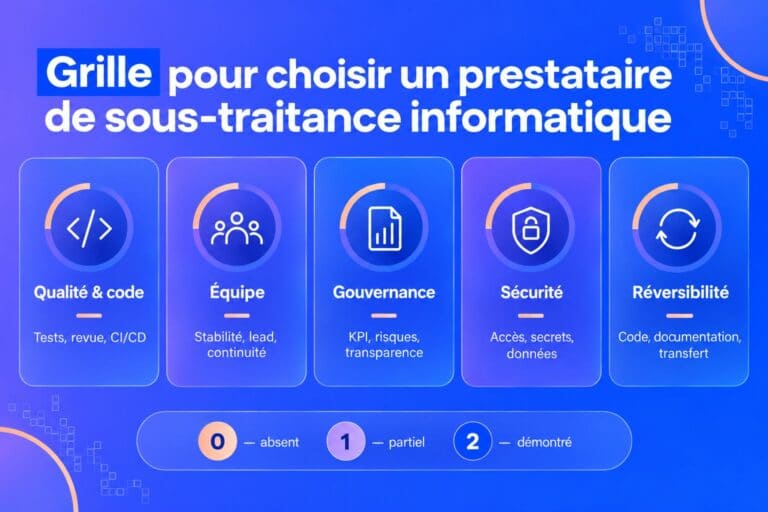
The country influences these criteria; it does not replace them. As we wrote in our guide on how to choose an IT outsourcing provider, poorly managed offshore work fails everywhere, and well-structured offshore work can succeed in several destinations.
Qualitative comparison table
| Madagascar | Mauritius | Morocco | Tunisia | Senegal | |
|---|---|---|---|---|---|
| Role of French | Official language with Malagasy | Everyday use, alongside English | Everyday use in business | Everyday use in business | Official language |
| Time difference with Paris (winter / summer) | +2 h / +1 h | +3 h / +2 h | −1 h / −2 h | 0 / −1 h | −1 h / −2 h |
| Distance | Long-haul | Long-haul | A few hours’ flight | A few hours’ flight | Medium-haul |
| IT ecosystem | Growing, focused on French-speaking clients | Established, internationally oriented | Mature, dedicated offshoring parks | Mature, strong engineering tradition | Developing |
| Key strength | Day-to-day collaboration in French | Bilingual and international projects | Proximity and a structured ecosystem | Engineering tradition | French-speaking, dynamic ecosystem |
This table is deliberately qualitative: figures on costs or talent volumes vary too much across sources, years and profiles to be reliably compared from one country to another.
Madagascar
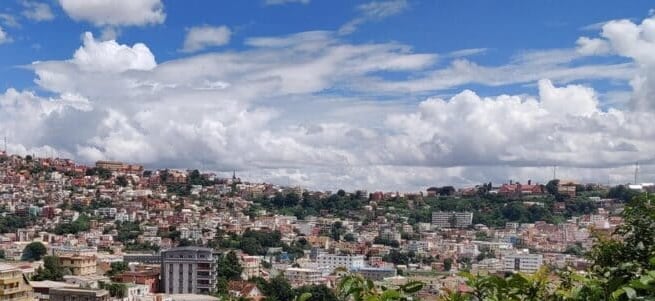
Strengths. Malagasy and French are the official languages, and French is the usual working language in tech companies. The country is on UTC+3 all year round, 1 to 2 hours ahead of Paris. Its software development and outsourcing sector has been built largely around French and French-speaking clients, with teams used to their expectations. The country offers a large pool of developers, trained at its universities and engineering schools, and a controlled budget.
At Etixio. Our engineers in Madagascar build business software, SaaS products, web and mobile applications and AI features for our clients. Learn more: our Madagascar page and our article on IT outsourcing in Madagascar.
Mauritius
Strengths. English and French are both in everyday use, making it a natural destination for bilingual products and international clients. The country is a member of both the Commonwealth and La Francophonie, and its universities train engineers who are used to working in English as well as French.
At Etixio. Our teams in Mauritius work alongside those in Madagascar: developers, QA engineers and product profiles, especially involved in bilingual projects and with international clients. See our Mauritius page.
Morocco
Strengths. Arabic and Amazigh are the official languages, and French is widely used in business and higher education. Morocco is one of the most structured offshoring destinations in the region, with business parks dedicated to offshoring in Casablanca, Rabat and other cities, and many international tech companies on the ground. Geographic proximity makes frequent visits easy.
Things to consider. Morocco returned to GMT on September 20, 2026: the difference with Paris is now one hour in winter and two hours in summer, with teams starting their day after yours. With many large companies present, the market for experienced profiles is very active, which is worth factoring into hiring plans.
Tunisia
Strengths. Arabic is the official language, and French is widely used in business and higher education. Tunisia has well-regarded engineering schools and a long tradition of IT services for French clients. It is on UTC+1 with no daylight saving time: the same time as Paris in winter, one hour behind in summer.
Things to consider. As in other North African countries, some engineers pursue their careers in Europe or North America. Documentation, knowledge sharing and supervision help keep teams stable over time.
Senegal
Strengths. French is the official language, and Wolof is widely spoken. The country is on GMT all year round. Dakar is home to a developing tech ecosystem, and digital technology is a stated priority of the public authorities.
Things to consider. Depending on the technologies needed, the pool of experienced developers is still growing, which may point toward moderately sized teams.
What about other destinations?
Other French-speaking countries, particularly in West and Central Africa, are seeing their tech ecosystems grow. They can fit specific needs, often with a well-established local provider. The same criteria apply: language, time difference, talent pool, stability, legal framework, total cost.
Outside the French-speaking world, destinations such as Vietnam offer strong scaling capacity, with English as the working language and a larger time difference. We compare them in Madagascar vs Vietnam.
Why Etixio chose the Indian Ocean
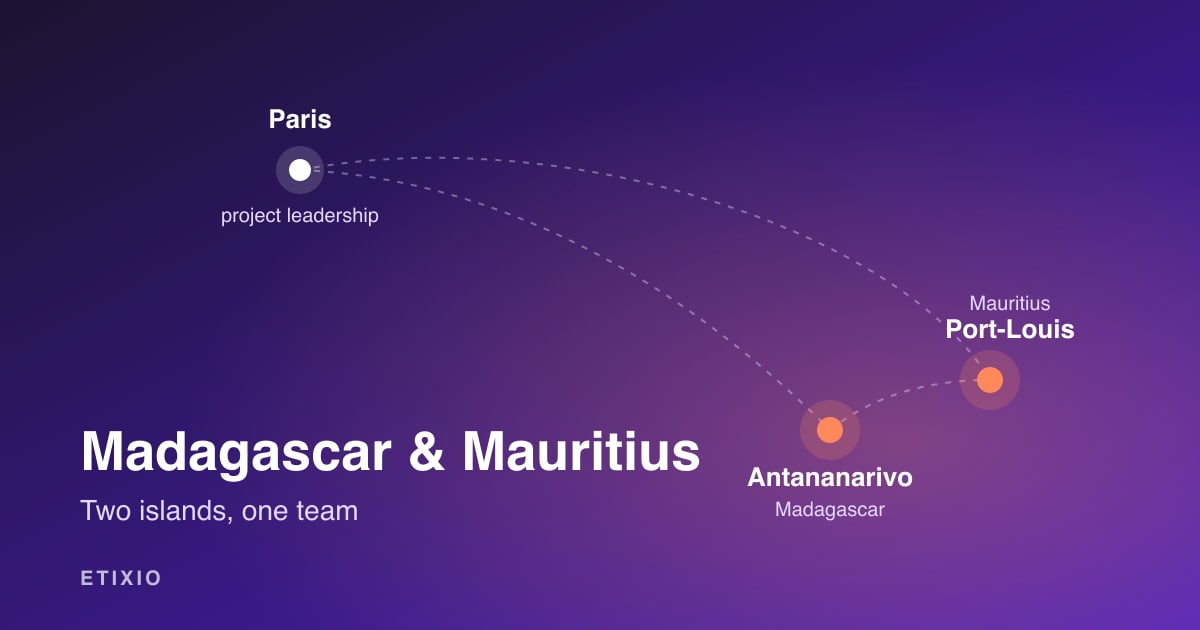
Etixio designs, builds and maintains software and AI solutions. Our engineering teams in Madagascar and Mauritius are how we deliver, managed from France and supervised by a tech lead. This choice rests on several reasons.
- French as a working language, with no intermediary, for clients whose users, business teams and documentation are in French.
- A time difference that puts teams ahead of Paris. Teams start their day before yours: issues from the day before can be handled before you arrive, and the shared window covers most of your office hours.
- Organized delivery continuity. Cloud-based tools and environments, redundant connections and workstations, backup power, the option to work remotely, handover between our teams in Madagascar and Mauritius, documentation and knowledge sharing, and leadership that tracks progress every day.
- Complementarity between the two islands. Madagascar for day-to-day collaboration in French on a controlled budget, Mauritius for bilingual projects and international clients. Only one hour separates the two countries, and a single team can be split between them. For a secure document sharing platform, we built a .NET and Flutter team split between Madagascar and Mauritius and managed as a single unit.
- The founders’ experience. Mathieu Bernard and Julien Goumet previously co-founded Bocasay, a software development company they grew to more than 170 people. Etixio builds on that experience of building and managing distributed teams.
In every case, we start from the work to be done, not the destination: the team’s makeup and its split between the two islands follow from your needs. See our organization and our Madagascar or Mauritius comparison.
Conclusion
Francophone offshore offers real options, each with its own strengths: proximity and maturity in North Africa, French-language work and complementarity in the Indian Ocean, momentum in Senegal. The right choice comes down to your criteria (language, time difference, talent, stability, legal framework, total cost) and to the strength of the partner, more than to the country itself.
Want to test these criteria against your project? Tell us about your context: we will tell you whether our organization is a fit, and why.
FAQ
Which countries can you outsource software development to in French?
The most common destinations for working in French are Morocco and Tunisia (often described as nearshore), Madagascar and Mauritius in the Indian Ocean, and Senegal in West Africa.
French does not have the same status everywhere: it is an official language in Madagascar and Senegal, and a language in everyday business use in Morocco, Tunisia and Mauritius.
What is the difference between francophone nearshore and offshore?
Nearshore refers to geographically close countries, such as Morocco or Tunisia, a few hours’ flight from Paris. Offshore refers to more distant destinations, such as Madagascar or Mauritius.
For day-to-day collaboration, what matters most is not distance but the time difference, and it is small in all of these countries.
What is the time difference with Paris for each destination?
Madagascar: "+2 h in winter, +1 h in summer. Mauritius: +3 h in winter, +2 h in summer. Tunisia: same time in winter, −1 h in summer. Morocco (on GMT since September 2026) and Senegal: −1 h in winter, −2 h in summer."
Is cost the right criterion for choosing an offshore destination?
Not on its own. The total cost of a team also depends on delivery quality, rework, team stability and the quality of management. The quality of supervision is what determines the real cost of delivered software. See our article on offshore development team cost.
Why does Etixio work in Madagascar and Mauritius?
Because the two islands combine working in French, a time difference that puts teams ahead of Paris, and complementarity between them: Madagascar for day-to-day collaboration in French, Mauritius for bilingual and international projects. A single team can be split across both.