Madagascar or Mauritius? For a development team working with a French or European company, the two islands have a lot in common: French is widely spoken, their time zones are close to Europe’s, and they belong to the same Indian Ocean region. Each has its own strengths. Madagascar is especially well suited to French-speaking organizations looking for a stable team on a controlled budget; Mauritius to projects where English and an international context matter more. And in many cases, the best answer is to combine the two, as Etixio does.
Our engineering teams work in both countries, managed from France and led by a tech lead. This article compares the two destinations without trying to name a “winner”: the right one is the one that fits your product, your working language and the people you work with.
Two Indian Ocean neighbors
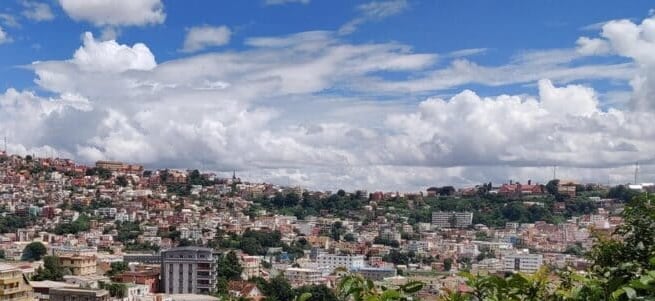
Madagascar, whose capital is Antananarivo, has Malagasy and French as official languages. French is the usual working language of tech teams, which are used to projects for French and French-speaking clients. To learn more, see our Madagascar page.
Mauritius, whose capital is Port Louis, lives across three languages: English, the language of government and much of the education system; French, widely used in business and the media; and Mauritian Creole in everyday life. The country is a member of both the Commonwealth and La Francophonie. For more details, see our Mauritius page.
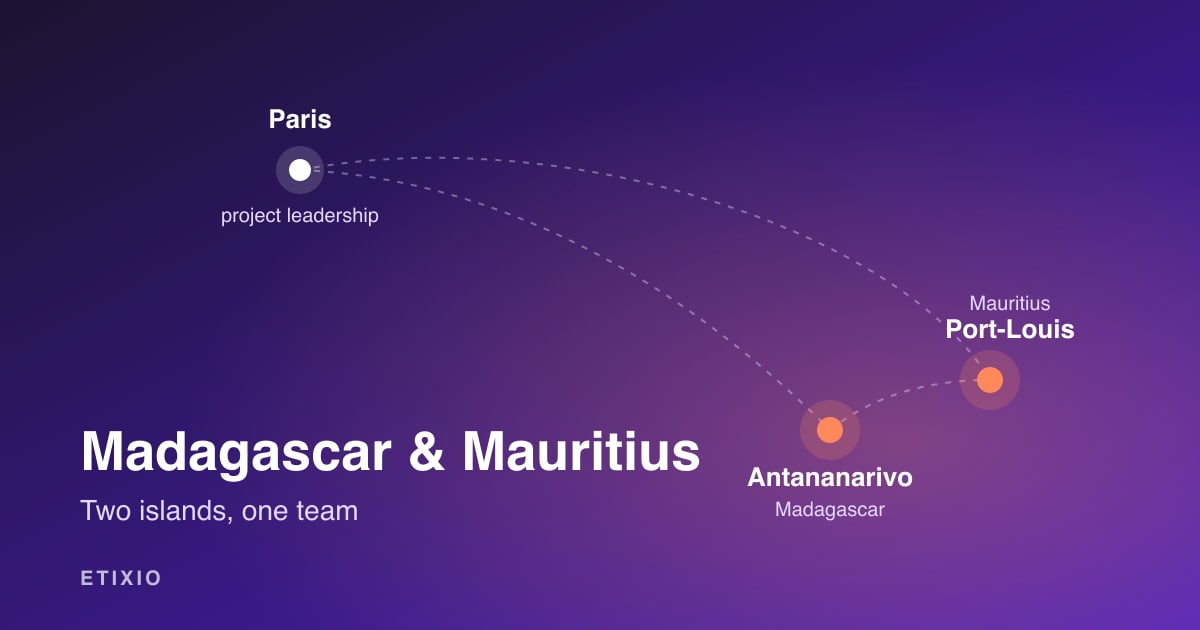
The two islands are only one hour apart and connected by direct flights, so a single team can work together across both in real time.
Side-by-side comparison
| Criterion | Madagascar | Mauritius |
|---|---|---|
| Working languages | French (Malagasy in everyday life) | English and French (Creole in everyday life) |
| Time difference with Paris | +2 h in winter, +1 h in summer (UTC+3) | +3 h in winter, +2 h in summer (UTC+4) |
| Talent | Large pool of French-speaking developers | Bilingual engineers, product and QA profiles |
| Typical projects | Business software, SaaS, maintenance, long-term teams | Bilingual products, international clients |
| Relative team cost | More moderate | Higher |
| Key strength | Day-to-day collaboration in French | Bilingual fluency and an international environment |
Working language
This is often the first criterion, and the most underestimated. In business software, the quality of functional scoping depends on understanding the nuances of a need expressed by users.
- In Madagascar, French is the natural working language of tech teams. For a fully French-speaking organization (leadership, business teams, Product Owner), it is the smoothest environment.
- In Mauritius, engineers switch between English and French over the course of the same day. If your documentation is in English, if your users are in several countries, or if part of your in-house team doesn’t speak French, that is a real advantage.
Time difference
Both islands are east of Paris and do not observe daylight saving time. Madagascar is 1 to 2 hours ahead, Mauritius 2 to 3 hours. In both cases, the shared window covers most of your working day: stand-ups, workshops, demos and production release follow-up all happen during your office hours. The one-hour gap between the two islands is no obstacle for a split team.
Talent
- Madagascar has a large pool of developers, trained at the country’s universities and engineering schools and used to working on projects for European clients: back-end, front-end, full-stack and mobile development, QA. This is where we most often build the core of our development teams.
- Mauritius offers university programs in computer science and software engineering, and engineers who are at ease in an international environment. Our teams there bring together developers, QA engineers and product profiles (Product Owner, Product Manager), often working directly with English-speaking stakeholders.
In both countries, very senior or highly specialized profiles take careful searching, as they do everywhere: that is one of the benefits of a split team.
Project types
Our teams on both islands deliver the same kinds of projects: business software, SaaS products, web and mobile applications, AI agents and AI features built into a product, taking an AI proof of concept through to production, and application maintenance.
The difference lies in the context. A product that requires a lot of day-to-day business discussion in French with French-speaking users fits naturally in Madagascar. A bilingual product, English documentation or stakeholders spread across several countries point toward Mauritius, or toward a team that combines both.
Relative cost
We won’t give figures here: they depend too much on seniority, tech stack and engagement model to be useful out of context. The principle, however, is stable: for comparable skills, a team represents a more moderate budget in Madagascar than in Mauritius.
But comparing day rates is not enough. The total cost of a team includes scoping time, delivery quality, rework, team stability and decision speed. We explain this reasoning in our article on offshore development team cost and on our pricing page.
Security and data
In both cases, data transfers from the European Union are governed by contract. Security depends first and foremost on organization: role-based access, separate environments, secrets management, traceability. See our article on offshore IT team governance.
When to favor one or the other
Madagascar is often the right choice if…
- your organization works in French, from leadership to end users;
- your product requires a lot of day-to-day business discussion (business software, B2B SaaS, application maintenance);
- you want a stable, long-term team on a controlled budget;
- you need a team of several people on widely used technologies.
Mauritius is often the right choice if…
- your product lives in both French and English (interface, documentation, support);
- the people you work with are international: subsidiaries, partners, clients outside France;
- part of your in-house team doesn’t speak French;
- the bilingual dimension is central to the project’s success.
Combining both, as Etixio does
The question isn’t always “one or the other.” At Etixio, several of our teams combine both islands. A split team makes it possible to:
- bring together all the skills the product needs;
- place the roles most involved in English-language communication in Mauritius and keep the core of the development team in Madagascar;
- organize handover between two sites, so work keeps moving in all circumstances;
- balance the overall budget.
This works because the team is managed as a single unit: same backlog, same repositories, same code reviews, same rituals and a shared tech lead.
Delivery continuity is part of that organization. Cloud-based tools and environments, redundant connections and workstations, backup power, the option to work remotely, handover between our teams on both islands, documentation and knowledge sharing so that nothing depends on a single person, and leadership that tracks progress every day.
A few examples:
- for a secure document sharing platform, a .NET and Flutter product team, with a Product Owner and QA, split between Madagascar and Mauritius and managed as a single unit;
- for a real estate data platform, developers in Madagascar and developers and a QA engineer in Mauritius, evolving the product continuously.
Depending on your situation, this takes the form of a team of developers in Madagascar, developers in Mauritius, or a split team. And if you’re comparing more broadly, our article on francophone offshore destinations also covers Morocco, Tunisia and Senegal.
Conclusion
Madagascar and Mauritius are not competitors but complements. Madagascar brings day-to-day collaboration in French and a more moderate budget; Mauritius brings bilingual fluency and an international environment. Brought together in a single team, their strengths add up: that is the organization we have chosen at Etixio.
In every case, the destination is no substitute for clear scoping, technical leadership and explicit delivery criteria. That framework is what makes a team succeed, on either island. Want to talk about your project? Contact us.
FAQ
Which is cheaper for software development, Madagascar or Mauritius?
For comparable skills, a team generally represents a more moderate budget in Madagascar than in Mauritius.
The real cost, however, depends on seniority, the tech stack, team size and above all on how the team is led: strong leadership is what prevents rework. See our offshore developer pricing.
What is the time difference between Paris, Madagascar and Mauritius?
Madagascar is on UTC+3 all year round: 2 hours ahead of Paris in winter, 1 hour ahead in summer.
Mauritius is on UTC+4 all year round: 3 hours ahead in winter, 2 hours ahead in summer. There is a one-hour difference between the two islands.
Is French spoken in Mauritius as it is in Madagascar?
In Madagascar, French is one of the official languages alongside Malagasy, and it is the usual working language in tech companies.
In Mauritius, French is widely used in the media and in business, but English dominates in government and education. Engineers there routinely work in both languages.
Can you build a team split between Madagascar and Mauritius?
Yes. Only one hour separates the two islands. With a shared backlog, tools, code reviews and tech lead, a split team works as a single product team. Etixio does this on several projects.
How does Etixio ensure delivery continuity across the two islands?
Through organization: cloud-based tools and environments, redundant connections and workstations, backup power, the option to work remotely, handover between our teams in Madagascar and Mauritius, shared documentation, and daily follow-up by the tech lead and project leadership in France.
Which destination suits a bilingual French-English product?
Mauritius is often the most natural choice when English is part of the project’s daily life. A mixed team, with its core in Madagascar and profiles in Mauritius for English-language communication, is also an option.