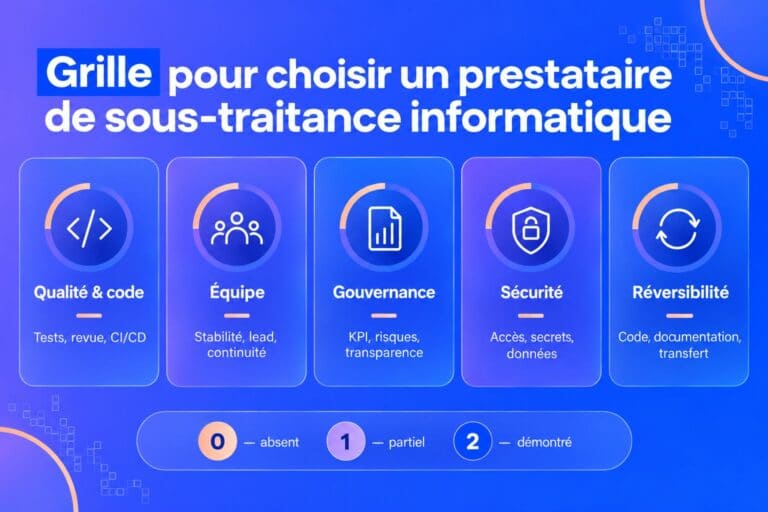
In a world where digital transformation is accelerating, many companies are wondering how to succeed with an IT outsourcing project with an offshore IT services company. IT outsourcing has become a structuring lever to accelerate delivery, secure quality and optimize the total cost of a project.
However, a successful offshore project doesn’t happen by chance. It requires rigorous preparation, a clear methodology and a reliable partner.
Let’s take the example of Madagascar, a rising destination for French-speaking offshore work, and see how Etixio has structured its approach to turn each project into a measurable success.
Succeeding with an IT outsourcing project with an offshore IT services company relies on a precise combination: scoping, governance, quality and security.

Understanding what is at stake in an offshore IT outsourcing project
Outsourcing an IT project may seem simple on paper. Yet behind the promises of lower costs and agility lie major strategic challenges.
Why companies choose IT outsourcing
The main motivations are clear:
- Lower operating costs
- Access to a pool of specialized talent
- Flexibility in team composition
- Shorter delivery times
- Focus on the core business
According to the World Bank, Africa’s digital sector is experiencing sustained growth, particularly in Madagascar (source: https://www.worldbank.org/).
The risks to anticipate
However, without a structured framework, risks can emerge:
- Misunderstanding of the initial need
- Communication and alignment issues
- Delays due to a lack of project governance
- Weaknesses in quality control and validation
It is precisely to avoid these pitfalls that a methodical approach becomes essential.
Succeeding with an offshore IT outsourcing project: the 9 essential levers
Here are the 9 concrete strategies:
1. Define clear, measurable objectives
A poorly scoped IT outsourcing project quickly drifts. Before starting, it is essential to align business, technical and budget objectives.
In practice, this means:
- An approved budget consistent with the ambition
- A realistic schedule
- Measurable key performance indicators (KPIs)
- Formalized acceptance criteria
Without this initial framework, trade-offs become unclear and governance weakens.
2. Write detailed specifications
Vague specifications are one of the main causes of rework in offshore projects. The more structured the need, the smoother the collaboration.
They should include:
- The functional scope
- Technical constraints
- Business priorities
- Expected deliverables
- Acceptance criteria
A structured document reduces areas of ambiguity and improves delivery quality.
3. Choose the right collaboration model
The contractual model directly influences the level of control and the flexibility of the project.
There are three main models:
- Time & materials
- Fixed-price
- Service center
The choice depends on internal maturity, the stability of the scope and the level of management the client wants to keep.
4. Set up effective communication
Communication is a key success factor in offshore projects. It must be structured, regular and transparent.
To achieve this:
- Use suitable collaboration tools (Slack, Jira, Microsoft Teams)
- Schedule regular meetings
- Document decisions
- Formalize meeting minutes
Well-framed communication prevents misunderstandings and secures alignment.
5. Appoint a point of contact on the client side
Without a clearly identified contact, projects lose their flow.
This person should:
- Centralize decisions
- Prioritize requests
- Settle blocking issues
- Ensure overall consistency
A single point of contact makes coordination easier and strengthens operational efficiency.
6. Hold regular meetings
A structured follow-up rhythm makes it possible to detect deviations quickly.
It is recommended to plan:
- A weekly operational meeting
- A risk review
- Monthly budget tracking
- Regular demos
Regular management is a key factor of stability.
7. Test continuously
Quality should never be a final phase. It must be built in from the start.
This involves:
- Unit tests
- Progressive functional validation
- Structured QA
- Checks before production release
A continuous approach limits late defects and secures the go-live.
8. Anticipate scaling up
A project rarely evolves in a linear way. Anticipating growth helps avoid organizational strain.
It is important to:
- Plan for changes in scope
- Structure the onboarding of new profiles
- Document knowledge
- Maintain a scalable architecture
The ability to adapt determines how durable the setup will be.
9. Nurture the human relationship
Even offshore, the human dimension remains central.
This involves:
- Regular exchanges
- Moments of synchronization
- A shared team culture
- Transparent feedback
Trust strengthens the stability of the partnership over the long term.
Preparing an offshore project or looking to structure your approach?
Why choose Madagascar as an offshore destination?
A pool of qualified talent
Madagascar has:
- Universities offering training in digital professions
- Engineers skilled in Java, PHP, Python and DevOps
- A strong mathematical and technical culture
- Profiles trained to international delivery standards and used to working with European organizations.
Stability, culture and French-speaking proximity
The strategic advantages:
- A time zone compatible with Europe
- Widespread command of French
- Strong cultural adaptability
- Competitive positioning in terms of total cost
This combination makes it an ideal destination for French-speaking companies looking to outsource smartly.
What are the essential criteria for choosing an offshore IT services company?
The success of your IT outsourcing project depends largely on the partner you select.
Transparency and organization
A well-structured IT services company should demonstrate:
- A clear methodology
- Modern collaboration tools
- Regular follow-up meetings
- Full traceability
Data security and confidentiality
Security should never be treated as a mere contractual clause, but as a permanent operational setup.
IT projects often involve sensitive data. It is essential to check:
- Cybersecurity policies
- GDPR standards
- Backup protocols
- Confidentiality agreements
The Etixio method: an approach designed for success
To understand how to succeed with an IT outsourcing project with an offshore IT services company, it is worth looking at Etixio’s methodology.
Initial audit and strategic scoping
Before anything starts:
- Detailed needs analysis
- Feasibility study
- Risk identification
- Definition of KPIs
This scoping avoids misunderstandings and secures the launch.
Building dedicated teams
The approach relies on a precise selection of profiles based on the business and technical context. The company:
- Selects profiles suited to the project
- Builds a stable dedicated team
- Assigns a dedicated project manager
This stability supports skills development and delivery continuity.
Agile management and transparent reporting
The Agile method is preferred:
- Short sprints
- Weekly meetings
- Shared dashboards
- Continuous adjustments
This transparency builds a lasting relationship of trust.
Case studies and feedback
Several projects supported by Etixio have shown:
- An average cost reduction of 30 to 40%
- Improved delivery times
- High client satisfaction
The key? Rigorous preparation and a partnership based on trust.
Success is above all strategic
Understanding how to succeed with an IT outsourcing project with an offshore IT services company takes much more than a simple price comparison.
It is a strategic choice that relies on:
- Rigorous preparation
- Clear governance
- Smooth communication
- A reliable partner
The example of Madagascar shows that a structured approach makes it possible to combine operational performance, software quality and budget control.
And when every step is thought through, structured and optimized, as Etixio does, success is no longer a matter of luck… but of method.
FAQ
Why do some offshore IT outsourcing projects run into difficulties?
The difficulties encountered in an offshore IT outsourcing project are most often linked to a lack of upfront structure rather than to a technical problem. They generally appear when scoping is insufficient, when objectives are not clearly defined or when project governance lacks regularity.
These situations are not specific to offshore, but they become more visible when several teams collaborate remotely. When they are anticipated from the start, they can actually help strengthen delivery quality, improve communication and secure deadlines.
To structure your project effectively and avoid these friction points, you can rely on proven delivery standards. Our guide to successful offshore IT outsourcing projects details the best practices, key steps and methods used on real projects.
Why choose Madagascar for IT outsourcing rather than another country?
Madagascar stands out for being French-speaking, for its cultural compatibility with European companies and for its convenient time zone. These factors make communication easier, reduce misunderstandings and speed up decision-making.
In addition, the country offers a good balance between technical skills, team commitment and cost competitiveness, making it a relevant destination for structured offshore projects.
How do you secure sensitive data in an offshore IT project?
Data security relies on a set of practices: access management (MFA, least privilege), environment separation, data encryption, activity logging and GDPR compliance.
A reliable partner puts these mechanisms in place from the start and builds them into project governance. Security should not be an add-on, but an integral part of delivery.
What is the real budget impact of an offshore IT project?
Offshore generally reduces costs by 30 to 50%, but the actual savings depend on how well the project is structured. A well-scoped setup optimizes costs while improving delivery quality and speed.
Conversely, a poorly organized project can generate hidden costs (delays, rework, technical debt). The analysis must therefore be based on total cost, not just the daily rate.
Which quality standards should you apply for a successful offshore IT project?
The quality of an offshore IT project relies on precise standards from the outset: systematic code review, automated testing, dedicated QA, CI/CD pipelines, documentation and clear acceptance criteria.
These elements secure delivery, limit technical debt and ensure stability over time. Without a structured quality framework, even a well-sized project can quickly drift.
To structure these practices effectively, you can rely on our guide to quality standards in IT outsourcing, which details the best practices, key indicators and methods used on demanding offshore projects.
How can you ensure the success of an offshore IT outsourcing project?
Success rests on several pillars: precise scoping, structured governance, smooth communication and performance-driven management. Having a point of contact on the client side (a Product Owner) is also essential to prioritize and align the teams.
To go further, you can read our complete guide to succeeding with your offshore IT outsourcing project, which details the key steps, best practices and mistakes to avoid.